What Does the Bible Say About Agreement?Matthew 18:19 says, “Again I say unto you, That if two of you shall agree on earth as touching anything that they shall ask, it shall be done for them of my Father which is in heaven” (KJV). Likewise, 1 Corinthians 1:10-11 says, “I appeal to you, brothers and sisters, in the name of our Lord Jesus Christ, that all of you agree with one another in what you say and that there be no divisions among you, but that you be perfectly united in mind and thought. My brothers and sisters, some from Chloe’s household have informed me that there are quarrels among you” (NIV). Brethren, there is power in agreement. Scripture calls on us to agree with one another in the mind of Christ and that by so doing whatever we ask will be done for us by our heavenly Father. As Christians, there should be no division among us but unity.
Agreement is a powerful theme that the Holy Spirit frequently teaches in Scripture. Furthermore, it is one of the most formidable kingdom principles through which we can get things done or accomplished. As a matter of fact, the power of agreement will work for any group of people who put it to work. Behold, there is no limit to what people can accomplish when they agree about it. In the Bible we see people putting this principle to work and God Himself testifying to the fact that nothing could be impossible for them because of the power of agreement. Brethren, united we stand, divided we fall. Matthew 12:25 says, Jesus knew their thoughts and said to them, “Every kingdom divided against itself will be ruined, and every city or household divided against itself will not stand.”
What the Bible Says About Agreement
Genesis 11:1-6 says, “Now the whole world had one language and a common speech. As people moved eastward, they found a plain in Shinar and settled there. They said to each other, “Come, let’s make bricks and bake them thoroughly.” They used brick instead of stone, and tar for mortar. Then they said, “Come, let us build ourselves a city, with a tower that reaches to the heavens, so that we may make a name for ourselves; otherwise we will be scattered over the face of the whole earth.” But the Lord came down to see the city and the tower the people were building. The Lord said, “If as one people speaking the same language they have begun to do this, then nothing they plan to do will be impossible for them.”
Notice that there is a great force at work when people stand or act in agreement. The very fact that God testified saying “nothing they plan to do will be impossible for them” is proof that the force or power of agreement really has no limits. It is interesting to note that the people mentioned here were not Christians. In fact, they seemed to have no knowledge of God nor revere Him. In addition, they were working against the very purposes of God which He stated in chapter 9 of Genesis as He blessed Noah and his family. Genesis 9:1 says, Then God blessed Noah and his sons, saying to them, “Be fruitful and increase in number and fill the earth.”
More Biblical Facts
The definite instruction in Genesis 9:1 was to replenish or refill the earth but these people desired to stay together and form their own small community with a high-minded purpose of building a tower that could reach Heaven. Behold, if these people could achieve whatever they imagined by being in agreement, there should be absolutely no limits to children of God who work together in agreement. Let’s look at some vital aspects of agreement that these people had and from them learn to harness and use the power of agreement. The Bible says that the people had one language (Genesis 11:1-6). This speaks about unity in what they said. As believers in Christ, we all have one language which is that of love. John 13:34 says, “A new command I give you: Love one another. As I have loved you, so you must love one another.”
For Christians to make an impact in their sphere of influence, there must not be found traces of disagreement in speech. Whatever is said must be fully inspired by love and as we know love unites rather than separate people. By keeping love in perspective, we embrace the mind of Christ and it’s not more about our own purposes but His. Still, in Genesis 11:1-6, we learn that the people journeyed together, effectively communicated, and embraced teamwork. This is an indication of agreement in vision and direction. Vision produces direction. People of the same destination travel together. Amos 3:3 says, “Do two walk together unless they have agreed to do so?” In order to achieve the success or breakthrough a group of people desires, they must move in the same direction and be committed to the same vision or goal. Likewise, there should be an effective communication (Colossians 4:6).
The Prayer of Agreement Leads to Breakthrough
Matthew 18:19 says, “Again I tell you, if two of you on earth agree (harmonize together, make a symphony together) about whatever (anything and everything) they may ask, it will come to pass and be done for them by My Father in heaven” (AMP). Brethren, Scripture reassures us as we dwell in Christ of an endless possibility of receiving for those who understand and take advantage of the power of agreement. Scripture teaches us that if together as believers in Christ we stand in agreement nothing shall be impossible for us. If a group of at least two believers in Christ stand in unity and agreement, whatever they ask for will be granted.
Thetus Tenney says, “Agreement is perhaps the untapped power of believers! What would be the results of real agreement among believers? If we will be led into perfect unity with Jesus Christ, having His mind in us so that we think as He would and ask according to his Word (John 15:7), and maintain unobstructed relationships between ourselves, having no resentments or unforgiveness toward others, we would open a channel through which God’s power could flow unobstructed.” Brethren, the prayer of agreement leads to a breakthrough. Below are some ways that will help you to pray in one accord:
Sincerely repent in Christ so that you can pray with a clean heart (John 9:31).
Pray with the Holy Spirit’s direction (Romans 8:26; John 14:26).
Pray with agreement in honesty and love (Matthew 18:19 ).
Pray God’s will according to Scripture (James 4:3; John 15:7).
Pray with faith and confidence believing that God has heard and will answer your prayers (Genesis 18:14; Hebrews 11:6; Matthew 21:22).
Pray with perseverance and urgency (Matthew15:21-28; Luke 18:1).
What Does the Bible Say About Agreement?
Matthew 18:19 – “Again I say to you, if two of you agree on earth about anything they ask, it will be done for them by my Father in heaven.“
1 Corinthians 1:10-11 – “I appeal to you, brothers, by the name of our Lord Jesus Christ, that all of you agree, and that there be no divisions among you, but that you be united in the same mind and the same judgment. For it has been reported to me by Chloe’s people that there is quarreling among you, my brothers.”
Amos 3:3 – “Do two walk together, unless they have agreed to meet?“
Colossians 2:8 – “See to it that no one takes you captive by philosophy and empty deceit, according to human tradition, according to the elemental spirits of the world, and not according to Christ.”
John 14:14 – “If you ask me anything in my name, I will do it.”
1 Corinthians 1:10-11 – “I appeal to you, brothers, by the name of our Lord Jesus Christ, that all of you agree, and that there be no divisions among you, but that you be united in the same mind and the same judgment. For it has been reported to me by Chloe’s people that there is quarreling among you, my brothers.”
2 Corinthians 6:16 – “What agreement has the temple of God with idols? For we are the temple of the living God; as God said, “I will make my dwelling among them and walk among them, and I will be their God, and they shall be my people.”
Group 1 – What Does the Bible Say About Agreement
John 9:31 – “We know that God does not listen to sinners. He listens to the godly person who does his will.“
Psalm 66:18 – “If I had cherished sin in my heart, the Lord would not have listened;“
1 Peter 3:8 – “Finally, all of you, be like-minded, be sympathetic, love one another, be compassionate and humble.“
James 4:3 – “When you ask, you do not receive, because you ask with wrong motives, that you may spend what you get on your pleasures.“
Genesis 18:14 – “Is anything too hard for the LORD? I will return to you at the appointed time next year, and Sarah will have a son.”
Hebrews 11:6 – “And without faith it is impossible to please God, because anyone who comes to him must believe that he exists and that he rewards those who earnestly seek him.“
Matthew 21:22 – “If you believe, you will receive whatever you ask for in prayer.”
Luke 18:1 – “Then Jesus told his disciples a parable to show them that they should always pray and not give up.”
Group 2 – What Does the Bible Say About Agreement
1 John 5:7-8 – “For there are three that testify: the Spirit and the water and the blood; and these three agree.”
Acts 2:1-47 – “When the day of Pentecost arrived, they were all together in one place. And suddenly there came from heaven a sound like a mighty rushing wind, and it filled the entire house where they were sitting. And divided tongues as of fire appeared to them and rested on each one of them. And they were all filled with the Holy Spirit and began to speak in other tongues as the Spirit gave them utterance. Now there were dwelling in Jerusalem Jews, devout men from every nation under heaven. …“
Colossians 3:17 – “And whatever you do, in word or deed, do everything in the name of the Lord Jesus, giving thanks to God the Father through him.”
1 John 4:18 – “There is no fear in love, but perfect love casts out fear. For fear has to do with punishment, and whoever fears has not been perfected in love.“
1 Corinthians 7:5 – “Do not deprive one another, except perhaps by agreement for a limited time, that you may devote yourselves to prayer; but then come together again, so that Satan may not tempt you because of your lack of self-control.”
Group 3 – What Does the Bible Say About Agreement
Matthew 5:37 – “Let what you say be simply ‘Yes’ or ‘No’; anything more than this comes from evil.”
Romans 8:3 – “For God has done what the law, weakened by the flesh, could not do. By sending his own Son in the likeness of sinful flesh and for sin, he condemned sin in the flesh,”
Philippians 2:1-5 – “So if there is any encouragement in Christ, any comfort from love, any participation in the Spirit, any affection and sympathy, complete my joy by being of the same mind, having the same love, being in full accord and of one mind. Do nothing from selfish ambition or conceit, but in humility count others more significant than yourselves. Let each of you look not only to his own interests, but also to the interests of others. Have this mind among yourselves, which is yours in Christ Jesus,“
Genesis 11:1-32 – “Now the whole earth had one language and the same words. And as people migrated from the east, they found a plain in the land of Shinar and settled there. And they said to one another, “Come, let us make bricks, and burn them thoroughly.” And they had brick for stone, and bitumen for mortar. Then they said, “Come, let us build ourselves a city and a tower with its top in the heavens, and let us make a name for ourselves, lest we be dispersed over the face of the whole earth.” And the Lord came down to see the city and the tower, which the children of man had built. …“
Group 4 – What Does the Bible Say About Agreement
1 John 5:14 – “And this is the confidence that we have toward him, that if we ask anything according to his will he hears us.“
Acts 2:38 – And Peter said to them, “Repent and be baptized every one of you in the name of Jesus Christ for the forgiveness of your sins, and you will receive the gift of the Holy Spirit.”
Romans 15:5 – “May the God of endurance and encouragement grant you to live in such harmony with one another, in accord with Christ Jesus,“
Matthew 18:19-20 – “Again I say to you, if two of you agree on earth about anything they ask, it will be done for them by my Father in heaven. For where two or three are gathered in my name, there am I among them.”
Philippians 4:13 – “I can do all things through him who strengthens me.”
1 John 1:9 – “If we confess our sins, he is faithful and just to forgive us our sins and to cleanse us from all unrighteousness.“
Nehemiah 9:38 – “Because of all this we make a firm covenant in writing; on the sealed document are the names of our princes, our Levites, and our priests.”
2 Timothy 1:7 – “For God gave us a spirit not of fear but of power and love and self-control.“
Group 5 – What Does the Bible Say About Agreement
Philippians 4:6 – “Do not be anxious about anything, but in everything by prayer and supplication with thanksgiving let your requests be made known to God.“
Matthew 6:33 – “But seek first the kingdom of God and his righteousness, and all these things will be added to you.”
Philippians 2:5 – “Have this mind among yourselves, which is yours in Christ Jesus,“
1 Timothy 2:4 – “Who desires all people to be saved and to come to the knowledge of the truth.”
John 1:1 – “In the beginning was the Word, and the Word was with God, and the Word was God.“
Romans 8:28 – “And we know that for those who love God all things work together for good, for those who are called according to his purpose.“
1 Peter 5:2 – “Shepherd the flock of God that is among you, exercising oversight, not under compulsion, but willingly, as God would have you; not for shameful gain, but eagerly;“
Group 6 – What Does the Bible Say About Agreement
Colossians 3:23 – “Whatever you do, work heartily, as for the Lord and not for men,“
Romans 5:8 – “But God shows his love for us in that while we were still sinners, Christ died for us.“
James 4:2 – “You desire and do not have, so you murder. You covet and cannot obtain, so you fight and quarrel. You do not have, because you do not ask.”
Romans 12:2 – “Do not be conformed to this world, but be transformed by the renewal of your mind, that by testing you may discern what is the will of God, what is good and acceptable and perfect.“
Romans 10:13 – For “everyone who calls on the name of the Lord will be saved.”
Romans 10:9 – “Because, if you confess with your mouth that Jesus is Lord and believe in your heart that God raised him from the dead, you will be saved.“
Isaiah 28:18 – “Then your covenant with death will be annulled, and your agreement with Sheol will not stand; when the overwhelming scourge passes through, you will be beaten down by it.“
Group 7 – What Does the Bible Say About Agreement
Jeremiah 29:11 – “For I know the plans I have for you, declares the Lord, plans for welfare and not for evil, to give you a future and a hope.“
Genesis 1:1-31 – “In the beginning, God created the heavens and the earth. The earth was without form and void, and darkness was over the face of the deep. And the Spirit of God was hovering over the face of the waters. And God said, “Let there be light,” and there was light. And God saw that the light was good. And God separated the light from the darkness. God called the light Day, and the darkness he called Night. And there was evening and there was morning, the first day. …“
Genesis 19:1-38 – “The two angels came to Sodom in the evening, and Lot was sitting in the gate of Sodom. When Lot saw them, he rose to meet them and bowed himself with his face to the earth and said, “My lords, please turn aside to your servant’s house and spend the night and wash your feet. Then you may rise up early and go on your way.” They said, “No; we will spend the night in the town square.” But he pressed them strongly; so they turned aside to him and entered his house. And he made them a feast and baked unleavened bread, and they ate. But before they lay down, the men of the city, the men of Sodom, both young and old, all the people to the last man, surrounded the house. …“
Group 8 – What Does the Bible Say About Agreement
1 Peter 5:7 – “Casting all your anxieties on him, because he cares for you.”
Deuteronomy 28:1-68 – “And if you faithfully obey the voice of the Lord your God, being careful to do all his commandments that I command you today, the Lord your God will set you high above all the nations of the earth. And all these blessings shall come upon you and overtake you, if you obey the voice of the Lord your God. Blessed shall you be in the city, and blessed shall you be in the field. Blessed shall be the fruit of your womb and the fruit of your ground and the fruit of your cattle, the increase of your herds and the young of your flock. Blessed shall be your basket and your kneading bowl. …“
Galatians 3:15 – “To give a human example, brothers: even with a man-made covenant, no one annuls it or adds to it once it has been ratified.”
2 Corinthians 13:14 – “The grace of the Lord Jesus Christ and the love of God and the fellowship of the Holy Spirit be with you all.“
John 14:27 – “Peace I leave with you; my peace I give to you. Not as the world gives do I give to you. Let not your hearts be troubled, neither let them be afraid.“
John 16:33 – “I have said these things to you, that in me you may have peace. In the world you will have tribulation. But take heart; I have overcome the world.”
Group 9 – What Does the Bible Say About Agreement
Psalm 18:32 – “The God who equipped me with strength and made my way blameless.”
Matthew 20:1-16 – “For the kingdom of heaven is like a master of a house who went out early in the morning to hire laborers for his vineyard. After agreeing with the laborers for a denarius a day, he sent them into his vineyard. And going out about the third hour he saw others standing idle in the marketplace, and to them he said, ‘You go into the vineyard too, and whatever is right I will give you.’ So they went. Going out again about the sixth hour and the ninth hour, he did the same. …“
Philippians 4:19 – “And my God will supply every need of yours according to his riches in glory in Christ Jesus.“
Ephesians 6:11-18 – “Put on the whole armor of God, that you may be able to stand against the schemes of the devil. For we do not wrestle against flesh and blood, but against the rulers, against the authorities, against the cosmic powers over this present darkness, against the spiritual forces of evil in the heavenly places. Therefore take up the whole armor of God, that you may be able to withstand in the evil day, and having done all, to stand firm. Stand therefore, having fastened on the belt of truth, and having put on the breastplate of righteousness, and, as shoes for your feet, having put on the readiness given by the gospel of peace. …“
Group 10 – What Does the Bible Say About Agreement
Ephesians 3:16 – “That according to the riches of his glory he may grant you to be strengthened with power through his Spirit in your inner being,“
Romans 8:38 – “For I am sure that neither death nor life, nor angels nor rulers, nor things present nor things to come, nor powers,”
Ephesians 2:8-9 – “For by grace you have been saved through faith. And this is not your own doing; it is the gift of God, not a result of works, so that no one may boast.“
Ephesians 3:20-21 – “Now to him who is able to do far more abundantly than all that we ask or think, according to the power at work within us, to him be glory in the church and in Christ Jesus throughout all generations, forever and ever. Amen.”
Acts 2:21 – “And it shall come to pass that everyone who calls upon the name of the Lord shall be saved.’“
Acts 2:8 – “And how is it that we hear, each of us in his own native language?“
Romans 15:4 – “For whatever was written in former days was written for our instruction, that through endurance and through the encouragement of the Scriptures we might have hope.“
Romans 8:38-39 – “For I am convinced that neither death nor life, neither angels nor demons, neither the present nor the future, nor any powers, neither height nor depth, nor anything else in all creation, will be able to separate us from the love of God that is in Christ Jesus our Lord.”
Group 11 – What Does the Bible Say About Agreement
Matthew 21:22 – “And whatever you ask in prayer, you will receive, if you have faith.”
John 3:16 – “For God so loved the world, that he gave his only Son, that whoever believes in him should not perish but have eternal life.“
Matthew 19:8 – He said to them, “Because of your hardness of heart Moses allowed you to divorce your wives, but from the beginning it was not so.”
Matthew 18:18 – “Truly, I say to you, whatever you bind on earth shall be bound in heaven, and whatever you loose on earth shall be loosed in heaven.”
Habakkuk 3:19 – “God, the Lord, is my strength; he makes my feet like the deer’s; he makes me tread on my high places. To the choirmaster: with stringed instruments.”
Matthew 6:24 – “No one can serve two masters, for either he will hate the one and love the other, or he will be devoted to the one and despise the other. You cannot serve God and money.“
Isaiah 41:10 – “Fear not, for I am with you; be not dismayed, for I am your God; I will strengthen you, I will help you, I will uphold you with my righteous right hand.”
Group 12 – What Does the Bible Say About Agreement
Proverbs 22:6 – “Train up a child in the way he should go; even when he is old he will not depart from it.”
Isaiah 40:31 – “But they who wait for the Lord shall renew their strength; they shall mount up with wings like eagles; they shall run and not be weary; they shall walk and not faint.”
Isaiah 28:15 – Because you have said, “We have made a covenant with death, and with Sheol we have an agreement, when the overwhelming whip passes through it will not come to us, for we have made lies our refuge, and in falsehood we have taken shelter”;
Psalm 37:21 – “The wicked borrows but does not pay back, but the righteous is generous and gives;“
Psalm 22:19 – “But you, O Lord, do not be far off! O you my help, come quickly to my aid!“
Joshua 1:10-18 – “And Joshua commanded the officers of the people, “Pass through the midst of the camp and command the people, ‘Prepare your provisions, for within three days you are to pass over this Jordan to go in to take possession of the land that the Lord your God is giving you to possess.’” And to the Reubenites, the Gadites, and the half-tribe of Manasseh Joshua said, “Remember the word that Moses the servant of the Lord commanded you, saying, ‘The Lord your God is providing you a place of rest and will give you this land.’ Your wives, your little ones, and your livestock shall remain in the land that Moses gave you beyond the Jordan, but all the men of valor among you shall pass over armed before your brothers and shall help them, …“
Group 13 – What Does the Bible Say About Agreement
Deuteronomy 8:18 – “You shall remember the Lord your God, for it is he who gives you power to get wealth, that he may confirm his covenant that he swore to your fathers, as it is this day.“
Joshua 1:9 – “Have I not commanded you? Be strong and courageous. Do not be frightened, and do not be dismayed, for the Lord your God is with you wherever you go.”
Numbers 30:2 – “If a man vows a vow to the Lord, or swears an oath to bind himself by a pledge, he shall not break his word. He shall do according to all that proceeds out of his mouth.”
Malachi 2:16 – “For the man who does not love his wife but divorces her, says the Lord, the God of Israel, covers his garment with violence, says the Lord of hosts. So guard yourselves in your spirit, and do not be faithless.”
2 Corinthians 12:9-10 – But he said to me, “My grace is sufficient for you, for my power is made perfect in weakness.” Therefore I will boast all the more gladly of my weaknesses, so that the power of Christ may rest upon me. For the sake of Christ, then, I am content with weaknesses, insults, hardships, persecutions, and calamities. For when I am weak, then I am strong.
Group 14 – What Does the Bible Say About Agreement
Matthew 6:34 – “Therefore do not be anxious about tomorrow, for tomorrow will be anxious for itself. Sufficient for the day is its own trouble.“
Matthew 24:1-51 – Jesus left the temple and was going away, when his disciples came to point out to him the buildings of the temple. But he answered them, “You see all these, do you not? Truly, I say to you, there will not be left here one stone upon another that will not be thrown down.” As he sat on the Mount of Olives, the disciples came to him privately, saying, “Tell us, when will these things be, and what will be the sign of your coming and of the end of the age?” And Jesus answered them, “See that no one leads you astray. For many will come in my name, saying, ‘I am the Christ,’ and they will lead many astray. …
Isaiah 12:2 – “Behold, God is my salvation; I will trust, and will not be afraid; for the Lord God is my strength and my song, and he has become my salvation.”
Isaiah 9:6 – “For to us a child is born, to us a son is given; and the government shall be upon his shoulder, and his name shall be called Wonderful Counselor, Mighty God, Everlasting Father, Prince of Peace.”
Group 15 – What Does the Bible Say About Agreement
Proverbs 3:5 – “Trust in the Lord with all your heart, and do not lean on your own understanding.”
Revelation 7:1-17 – “After this I saw four angels standing at the four corners of the earth, holding back the four winds of the earth, that no wind might blow on earth or sea or against any tree. Then I saw another angel ascending from the rising of the sun, with the seal of the living God, and he called with a loud voice to the four angels who had been given power to harm earth and sea, saying, “Do not harm the earth or the sea or the trees, until we have sealed the servants of our God on their foreheads.” And I heard the number of the sealed, 144,000, sealed from every tribe of the sons of Israel: 12,000 from the tribe of Judah were sealed, ...”
Proverbs 22:26 – “Be not one of those who give pledges, who put up security for debts.“
Revelation 1:1-20 – “The revelation of Jesus Christ, which God gave him to show to his servants the things that must soon take place. He made it known by sending his angel to his servant John, who bore witness to the word of God and to the testimony of Jesus Christ, even to all that he saw. Blessed is the one who reads aloud the words of this prophecy, and blessed are those who hear, and who keep what is written in it, for the time is near. John to the seven churches that are in Asia: Grace to you and peace from him who is and who was and who is to come, and from the seven spirits who are before his throne, and from Jesus Christ the faithful witness, …“
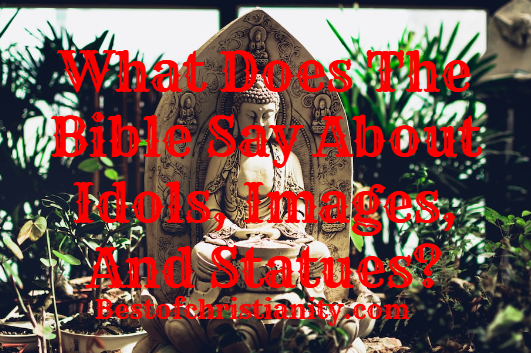
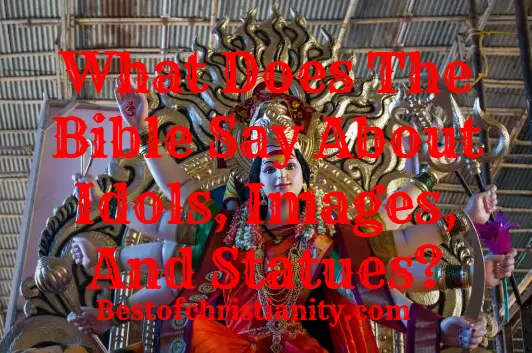
What Does The Bible Say About Idols, Images, And Statues?Thou Shalt Not Make Unto Thee Any Graven Image. A graven image is an idol—an object or image, such as a statue, that is worshiped as the representation of a deity or god. The word graven means “carved” or “sculpted.” False worship is the worship of idols, images, and/or statues which are all false gods because there is Only One True God, Almighty and Sovereign who deserves divine worship. “You shall not make for yourself any idol, or any likeness (form, manifestation) of what is in heaven above or on the earth beneath or in the water under the earth [as an object to worship]” (AMP, Exodus 20:4). “You shall not make for yourself a carved image, or any likeness of anything that is in heaven above, or that is in the earth beneath, or that is in the water under the earth” (ESV, Exodus 20:4). “Thou shalt not make unto thee any graven image, or any likeness of any thing that is in heaven above, or that is in the earth beneath, or that is in the water under the earth:” (KJV, Exodus 20:4). First found in Exodus 20:4, the popular phrase “graven image” comes from the King James Version of the Bible in the first (for Catholics) and second (for some Protestants) of the Ten Commandments from the Lord God Almighty. It’s important to take note that the Hebrew word translated “graven image” means literally “an idol.” “Thou shalt not make unto thee any graven image” (Hebrew: לֹא-תַעֲשֶׂה לְךָ פֶסֶל, וְכָל-תְּמוּנָה, romanized:Lōʾ-t̲aʿăśeh lək̲ā p̲esel, wək̲ol-təmûnāh) is an abbreviated form of one of the Ten Commandments that were spoken by the Lord God to His children, and then written on stone tablets by His Finger. Notice that through Jesus Christ, we are made children of God. John 1:12 says, “But to all who did receive him, who believed in his name, he gave the right to become children of God,“
What is a graven image? In simple terms, a graven image is an image carved out of stone, wood, or metal. A graven image could be a statue of a person or an animal or a relief carving on a wall or pole. A molten image is melted metal poured into a cast. Functionally, there is no difference between a “graven” image (Deuteronomy 4:16) and a “molten” image (Exodus 34:17). When worshipped, both become signs of man’s waywardness. Abstract Asherah poles, carved wooden Ba’als covered in gold leaf, and etchings of gods accompanying Egyptian hieroglyphics all fall under graven images. Though it may not be the carved or manmade gods of stone, wood, or metal common in the Old Testament, Christians today must be careful not to make their jobs, wealth, families, money, reputations, businesses, or anything else the center of their affections. For there is only One Living God, worthy of all our adoration and worship.
What Does The Bible Say About Idols, Images, And Statues?
What The Scriptures Say About Worshiping False gods (Idols)
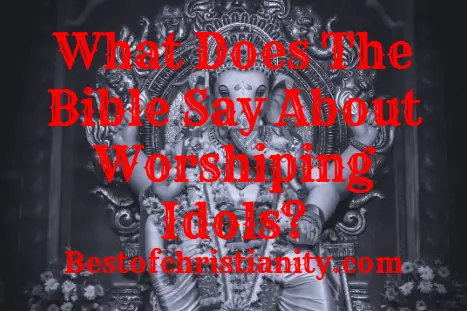
The Bible clearly forbids the worship of idols and calls on everyone to worship only the One and True God, Almighty, and Sovereign (Exodus 20:4). Exodus 20:1-26 says, And God spoke all these words, saying, “I am the Lord your God, who brought you out of the land of Egypt, out of the house of slavery. “You shall have no other gods before me. “You shall not make for yourself a carved image, or any likeness of anything that is in heaven above, or that is in the earth beneath, or that is in the water under the earth. You shall not bow down to them or serve them, for I the Lord your God am a jealous God, visiting the iniquity of the fathers on the children to the third and the fourth generation of those who hate me, … 1 Corinthians 10:14 says, “Therefore, my dear friends, flee from idolatry.” 1 John 5:21 says, “Dear children, keep yourselves from idols.” Colossians 3:5 says, “Put to death, therefore, whatever belongs to your earthly nature: sexual immorality, impurity, lust, evil desires and greed, which is idolatry.“ Isaiah 45:20 says, “Gather together and come; assemble, you fugitives from the nations. Ignorant are those who carry about idols of wood, who pray to gods that cannot save.” Jonah 2:8 says, “Those who cling to worthless idols turn away from God’s love for them.“
Galatians 4:8 says, “Formerly, when you did not know God, you were slaves to those who by nature are not gods.“ Psalms 16:4 says, “Those who run after other gods will suffer more and more. I will not pour out libations of blood to such gods or take up their names on my lips.“ Leviticus 19:4 says, “‘Do not turn to idols or make metal gods for yourselves. I am the LORD your God.“ Revelation 9:20 says, “The rest of mankind who were not killed by these plagues still did not repent of the work of their hands; they did not stop worshiping demons, and idols of gold, silver, bronze, stone and wood—idols that cannot see or hear or walk.“ Galatians 5:19-21 says, “The acts of the flesh are obvious: sexual immorality, impurity and debauchery; idolatry and witchcraft; hatred, discord, jealousy, fits of rage, selfish ambition, dissensions, factions and envy; drunkenness, orgies, and the like. I warn you, as I did before, that those who live like this will not inherit the kingdom of God.“
Biblical Warning Against Idolatry
In Exodus 20:4-5, we get one of the commandments which reads, “You shall not make for yourself an idol, or any likeness of what is in heaven above or on the earth beneath or in the water under the earth. You shall not worship them or serve them.” Notice how this is similar to the commandment, “You shall have no other gods before Me,” and specifically forbids the creation of idols. Psalms 135:15-18 says, “The idols of the nations are silver and gold, made by human hands. They have mouths, but cannot speak, eyes, but cannot see. They have ears, but cannot hear, nor is there breath in their mouths. Those who make them will be like them, and so will all who trust in them.”
Exodus 3:6 says, And he said, “I am the God of your father, the God of Abraham, the God of Isaac, and the God of Jacob.” And Moses hid his face, for he was afraid to look at God. Exodus 3:14 says, God said to Moses, “ I AM WHO I AM.” And he said, “Say this to the people of Israel: ‘ I AM has sent me to you.’” Nehemiah 9:6 says, “You are the LORD, you alone. You have made heaven, the heaven of heavens, with all their host, the earth and all that is on it, the seas and all that is in them; and you preserve all of them; and the host of heaven worships you.” With all these in mind, we should Worship God Alone.
Idolatry in a Pagan Religion
Generally, idolatry in a pagan religion starts with the acknowledgment of a power that controls natural forces. The presence of the force is then thought to indwell a place, like a mountain or a water body, or an object like a stone or a tree. The next thing is altering a naturally occurring environment or object, like a waterfall, a standing stone, a deliberately planted tree, or a carved Asherah pole, and calling on the force to indwell it. When the idolatrous culture has had time to contemplate the personality of the god, they then make corresponding physical images. That’s, they make statues or relief carvings in the form of things in heaven, on earth, and under the earth for worship. Places are set aside to commune with these false gods. For convenience’s sake, smaller items, thought to hold the communication line or power of the gods, are brought into homes and some are carried along on the go. And as such, those involved find themselves ensnared by the compulsion to give homage to a thing of their own definition instead of giving it to the Lord God Almighty, Creator of the Universe.
Do Catholics Worship Idols, Images, or Statues?
Catholics do not worship such, but rather use images and statues to learn, understand, explain, and/or portray the heavenly ministries. It’s important to understand that to portray means to depict (someone or something) in a work of art or literature. Early Christians had religious art. The church formerly confirmed the use of statues and other art as a means of veneration at the Second Council of Nicaea in 787 A.D. Behold, they clarified, approved, and encouraged the honoring of Our Lord, Our Lady, saints, and angels, through the proper use of statues. Notice that 787 was way before Protestantism came into existence. Those who claim that Catholics worship images are simply propagandists deceived by mere interpretations of Scripture. While we are not out to argue with them, we simply have an answer to explain to those who are sincere and willing to know. Titus 3:9 says, “But avoid foolish and ill-informed and stupid controversies and genealogies and dissensions and quarrels about the Law, for they are unprofitable and useless.“ 1 Peter 3:15 says, “But in your hearts set Christ apart [as holy—acknowledging Him, giving Him first place in your lives] as Lord. Always be ready to give a [logical] defense to anyone who asks you to account for the hope and confident assurance [elicited by faith] that is within you, yet [do it] with gentleness and respect.“
It’s without a doubt that images are part of the instruments for learning. Anybody and anything can be called an image depending on what one uses it for. This means that human beings, animals, plants, stones, carvings, and other things could be images. Hebrews 11:3 says, “By faith we understand that the universe was created by the word of God, so that what is seen was not made out of things that are visible.” Notice that the Bible, Church buildings, crucifixes, statues, and others are all images. In addition, man is created in the image of God. Genesis 1:27 says, “So God created man in his own image, in the image of God he created him; male and female he created them.” Also, Jesus is the image of the invisible God (John 14:9; John 1:14). Colossians 1:15 says, “He is the image of the invisible God, the firstborn of all creation.” Likewise, the Holy Spirit is the image of God (Genesis 1:2). Similarly, the Bible is an image through which we learn the Word of God. Notice that the Bible is not God in itself. And as such, the readers of the Bible do not worship it. They rather worship the Lord God who is revealed through the Scriptures. If this is logical, then you should understand that Catholics do not worship images which are merely pointing to hidden realities of their faith.
It’s important to understand that as a “Universal” Church, the Catholic Church employs different techniques to dispatch her message to all categories of people without discrimination: the learned and the unlearned, the rich and the poor, the blind and the lame, the deaf and the mute, as well as others. In doing this, she makes use of the Bible, the tradition, the teachings of her leaders, the images, signs, and symbols. Note that in all her techniques to transmit God’s message to everyone, she clearly knows, understands, and acknowledges the Lord God as the ultimate and only one to be worshiped (Exodus 20:2–5). In fact, the Catholic Church does not believe any statue or image has any power in and of itself. The beauty of icons and statues moves us to the contemplation of God’s Word as He is Himself or as He works in His saints.
Catholics make use of statues, paintings, and mosaics as a reminder of those who have gone before them. As saints, they point in the direction of Christ through the virtues of their lives. Remembering them reminds one of the virtues he/she should pursue. Notice that before the invention of photographs, man-made images were the only things that could be used as physical reminders of these people. In the same way, Jews used graven images in the manner the Lord God commanded them to, and those who followed God’s Law in the Old Testament understood that those religious images were not to be offered adoration and worship, Catholics do not worship statues today.
The Catechism of the Catholic Church states: 2113 Idolatry not only refers to false pagan worship. It remains a constant temptation to faith. Idolatry consists in divinizing what is not God. Man commits idolatry whenever he honors and reveres a creature in place of God, whether this be gods or demons (for example, satanism), power, pleasure, race, ancestors, the state, money, etc. Jesus says, “You cannot serve God and mammon.” Many martyrs died for not adoring “the Beast” refusing even to simulate such worship. Idolatry rejects the unique Lordship of God; it is therefore incompatible with communion with God.
The Catholic Church during the Council of Trent (1545 – 1563) issued a clear statement concerning images and statues. According to the 25th session of this General Council: The images of Christ and of the Virgin Mother of God, and of the saints are to be had and retained particularly in churches, and due honor and veneration are to be given them; not that any divinity or virtue is believed to be in them on account of which they are to be worshipped, or that anything is to be asked of them, or that trust is to be reposed in images, as was of old by the Gentiles, who placed their hopes in idols; but because the honor which is shown them is referred to the prototypes which these images represent; so that we through the images which we kiss…or bend the knee, adore Christ and venerate the saints, whom they represent. [The Canons & Decrees of the Council of Trent (TAN Books, 1978) p. 215-6]
What About Catholics Bowing Before Images And Statues?
Many anti-Catholics cite Deuteronomy 5:9, where the Lord God said concerning idols, “You shall not bow down to them.” Since many Catholics sometimes bow or kneel in front of statues of Jesus and the saints, anti-Catholics confuse the legitimate veneration of a sacred image with the sin of idolatry. As Christians, it’s important for us to understand that though bowing can be used as a posture in worship, not all bowing is worship. In Japan, people show respect by bowing in greeting (the equivalent of the Western handshake). Similarly, a person can kneel before a king without necessarily worshiping him as a god. The Bible presents Abigail as a woman of great wisdom and beauty who in her wisdom and knowledge about the Lord God and His ways, bowed down before David with her face to the ground bringing to him divine counseling, preventing him from sinning, prophesying his kingship, and causing him to give praise to the name of the Lord God (1 Samuel 25). Pleased with her, and amazed by her wisdom, David later took her in as one of his wives (1 Samuel 25:39-43). The Bible also recounts how King Solomon, heir of King David, knelt before the altar of the Lord God with his hands spread up to heaven (1 Kings 8:54). Does this mean that Solomon was worshiping the altar or heaven? Absolutely not. In the same way, a Catholic who may kneel in front of a statue while praying isn’t worshiping the statue nor praying to it, any more than a Protestant who kneels with a Bible in his hands when praying is worshiping the Bible or praying to it.
However, the Catholic Church does not compel her members to kneel or pray before images since they have no ears to hear nor the power to help. The Church allows for the veneration of images as long as the honor is directed toward Christ and His Saints. Some Christians may object to the veneration of images of the saints since they believe that honor should be directed toward God alone and not toward Mary or the Saints. After all, 1 Timothy 1:17 says, “Now to the King of the ages [eternal], immortal, invisible, the only God, be honor and glory forever and ever. Amen.” Behold, this objection arises from a confusion between divine honor (adoration – supreme honor proper only for the Lord God Almighty) and respectful honor proper for men. In the Bible, the people of God bowed down before King David to show him honor (2 Samuel 24:20; 1 Chronicles 29:20; 21:21). Likewise, Obadiah in 1 Kings 18:7 fell prostrate before Elijah showing him reverence for being a prophet of the Lord God. In the Ten Commandments, we are told to honor our mother and father (Deuteronomy 5:16). Notice that even our Lord and Savior, Jesus Christ, defended and obeyed this commandment (Mark 7:9-13; Luke 2:51). The Catholic Church honors Mary in imitation of Jesus (1 Corinthians 11:1). John 19:26-27 says, When Jesus saw his mother and the disciple whom he loved standing nearby, he said to his mother, “Woman, behold, your son!” Then he said to the disciple, “Behold, your mother!” And from that hour the disciple took her to his own home.
Are Catholics Omitting or Hiding the Second Commandment in Order to Worship or Promote the Worship of Images and Statues?
There are a lot of misleading writings portraying the Catholic Church as being behind the New World Order. These writings attempt to prove this claim by exposing the “marks of the beasts” (Revelation 17). One of the main charges frequently used is the alteration of God’s commandments. These writings claim that the Catholic Church dropped, omitted, or are hiding the “Second Commandment” which forbids “graven images.” Allegedly, the Catholic Church condones statue worship. However, are Catholics omitting or hiding the second commandment in order to worship or promote the worship of images and statues? Absolutely No. The Catechism of the Catholic Church states: 2132 The Christian veneration of images is not contrary to the first commandment which proscribes idols. Indeed, “the honor rendered to an image passes to its prototype,” and “whoever venerates an image venerates the person portrayed in it.” The honor paid to sacred images is a “respectful veneration,” not the adoration due to God alone:
Religious worship is not directed to images in themselves, considered as mere things, but under their distinctive aspect as images leading us on to God incarnate. The movement toward the image does not terminate in it as image, but tends toward that whose image it is. (St. Thomas Aquinas)
Sadly, some Protestants think that the Catholic Church “hides” the second commandment. This is because in Catholic Catechisms, the first commandment is often listed as “You shall have no other gods before me” (Exodus 20:3), and the second is listed as “You shall not take the name of the Lord in vain” (Exodus 20:7). From this, it is argued that Catholics have deleted the prohibition of idolatry to justify their use of religious statues. However, this is false. The truth is that Catholics simply group the commandments differently from most Protestants. In Exodus 20:2-17, from which the Ten (10) Commandments are derived, there are actually fourteen (14) imperative statements. To arrive at the Ten Commandments, some statements have to be grouped together, and there is more than one way of doing this. Since, in the ancient world, polytheism and idolatry were always unite – idolatry being the outward expression of polytheism – the historic Jewish numbering of the Ten Commandments have always grouped together the imperatives “You shall have no other gods before me” (Exodus 20:3) and “You shall not make for yourself a graven image” (Exodus 20:4). The historic Catholic numbering follows the Jewish numbering on this point, as does the historic Lutheran numbering.
It is important to understand that Jews and Christians abbreviate the commandments so that they can be easily remembered using a summary, ten-point formula. For example, Jews, Catholics, and Protestants typically summarize the Sabbath commandment as, “Remember the Sabbath to keep it holy,” though the commandment’s actual text takes four verses, “Remember the Sabbath day, to keep it holy. Six days you shall labor, and do all your work, but the seventh day is a Sabbath to the Lord your God. On it you shall not do any work, you, or your son, or your daughter, your male servant, or your female servant, or your livestock, or the sojourner who is within your gates. For in six days the Lord made heaven and earth, the sea, and all that is in them, and rested on the seventh day. Therefore the Lord blessed the Sabbath day and made it holy” (Exodus 20:8–11).
Note that when the prohibition of idolatry or polytheism (the belief in or worship of more than one god) is summarized, Jews, Catholics, and Lutherans abbreviate it as “You shall have no other gods before me.” As a matter of fact, this is no attempt to “hide” the idolatry prohibition (notice that Jewish and Lutherans don’t even use statues of saints and angels). Brethren, don’t let yourself to be deceived as it is all about making the learning process of the Ten Commandments easier. So, where does the specific numbering controversy occur? Some Christians view the second commandment to be: “You shall not make for yourself a graven image, or any likeness of anything that is in heaven above, or that is on the earth beneath, or that is in the water under the earth; you shall not bow down to them or serve them” (Deuteronomy 5:8-9). They then group the directives, “Neither shall you covet your neighbor’s wife; and you shall not desire your neighbor’s house… field… or anything that is your neighbor’s” (Deuteronomy 5:21), into one as the Tenth Commandment. On the other hand, Catholics consider the verses forbidding the making and worshiping of graven images to be part of the First Commandment: “I, the Lord, am your God. You shall not have other gods besides me.” In the Catechism of the Catholic Church, the un-summarized First Commandment reads: “I am the LORD your God… You shall have no other gods before me. You shall not make for yourself a graven image, or any likeness of anything… in heaven… in the earth… or… in the water… you shall not bow down to them or serve them” (Exodus 20:2-5). With this in mind and unlike what some Protestants think, it’s clear that Catholics as well as the Jewish and Lutherans have not removed or omitted the “Second Commandment,” but have included the directives forbidding creating and worshiping graven images in the First Commandment, because they are naturally part of it: to worship the Lord God Almighty alone, and nothing else anywhere. Catholics then consider the Ninth Commandment as, “you shall not covet your neighbor’s wife”, and the Tenth as “you shall not desire your neighbor’s house… field… or anything that is your neighbor’s”, recognizing the dignity of a person’s spouse and not grouping them with a person’s general possessions. This clearly distinguishes the desire (lust) to commit adultery from the desire (greed) to steal. This division scheme was advocated by St. Augustine in his writings on Exodus.
But what about the numbering of the Ten Commandments? Behold, the Bible clearly states that the Lord God gave Moses several directives under the form of Ten Commandments (Deuteronomy 4:13), but does not group or number them specifically (and they can be eventually grouped into ten groups in more than one reasonable way). Consequently, while the Catholic Church has clearly defined all the teachings contained in the Ten Commandments, it has not dogmatically defined how they are to be organized/numbered. The Catechism of the Catholic Church says, “The division and numbering of the Commandments have varied in the course of history. The present catechism follows the division of the Commandments established by Augustine, which has become traditional in the Catholic Church. It is also that of the Lutheran confession. The Greek Fathers worked out a slightly different division, which is found in the Orthodox Churches and Reformed communities” (CCC 2066). The present Catechism follows the numbering proposed by St. Augustine – which was also the numbering adopted by Martin Luther, best known as the seminal figure in the Protestant Reformation and the namesake of Lutheranism. Sadly, many Protestants are unware of this interesting detail about Martin Luther who stands in history as a leader and father of the Protestant Reformation.
Ten (10) Commandments (Exodus 20)
Abbreviated Catholic Ten Commandments
I, the Lord, am your God. You shall not have other gods besides me.
You shall not take the name of the Lord God in vain
Remember to keep holy the Lord’s Day
Honor your father and your mother
You shall not kill
You shall not commit adultery
You shall not steal
You shall not bear false witness
You shall not covet your neighbor’s wife
You shall not covet your neighbor’s goods
Abbreviated Protestant Ten Commandments
You shall have no other gods but me.
You shall not make unto you any graven images
You shall not take the name of the Lord your God in vain
You shall remember the Sabbath and keep it holy
Honor your mother and father
You shall not murder
You shall not commit adultery
You shall not steal
You shall not bear false witness
You shall not covet anything that belongs to your neighbor
The Religious uses of Images in the Old and New Testament
In the Old Testament, we read how disaster came upon the chosen people of God because of their waywardness and they had to look at the bronze statue of the serpent to be healed, which shows that statues could be used ritually, not merely as religious decorations. Numbers 21:8–9 says, Then the Lord said to Moses, “Make a fiery serpent [of bronze] and set it on a pole; and everyone who is bitten will live when he looks at it.” So Moses made a serpent of bronze and put it on the pole, and it happened that if a serpent had bitten any man, when he looked to the bronze serpent, he lived. Catholics use statues, paintings, and other artistic devices to recall the person or thing depicted. Just as it helps remember one’s father or mother by looking at his or her photograph, so it helps to recall the example of the saints by looking at their pictures. Catholics also use statues as teaching tools. In the early Church, statues were especially useful for the instruction of the illiterate. Many Protestants have pictures and artistic works portraying Jesus as well as other Biblical characters in Sunday school for teaching children. Likewise, Catholics use statues to commemorate certain people and events, much as Protestant churches have three-dimensional nativity scenes at Christmas. Notice that if a person measured Protestants by the same rule, then by using these “graven” images they would equally be practicing the “idolatry” of which they accuse Catholics. But there is no idolatry going on in these situations. Note that God forbids the worship of images as gods, but He does not ban the making of images. In fact, it’s when people begin to adore a statue as a god that the Lord’s command is broken and He becomes angry. Inline with this, when the people did start to worship the bronze serpent as a snake-god (whom they named “Nehushtan”), the righteous king Hezekiah had it destroyed (2 Kings 18:4).
In the New Testament, Galatians 3:1 says, “O foolish Galatians! Who has bewitched you? It was before your eyes that Jesus Christ was publicly portrayed as crucified.” Remember that to portray means to depict (represent someone or something by a drawing, painting, or other art form) in a work of art or literature. And here, Apostle Paul makes us understand that Jesus Christ was publicly portrayed as crucified before the very eyes of the Galatians. Behold, the Galatians had seen an image of Christ crucified. They had seen a crucifix! The question we are asking ourselves now is that to know whether it was a live representation of Christ crucified, or was it a carved image – a graven image – of Christ crucified? We can’t really be sure about this, but one thing is for sure, they were looking at an image of Christ on the cross – a crucifix.
Sacred art is used to evangelize, catechize, and inspire. It’s also used to show reverence and honor for the Lord God and His Saints. When a Catholic kneels or bows in prayer before a statue, they are not worshiping it in any way whatsoever. They are simply using it as a person might use the picture of his family – to recall them, even pray for them, when he is not physically with them. As a matter of fact, he/she does not consider a picture of his/her children as being his/her actual children, but merely a reminder of them. And so it is with sacred art in any form. Such is used ultimately to raise our hearts and minds to God – to aid us in prayer. It’s important to understand that the Catholic Church strictly condemns the adoration (divine worship) of statues, images, or even the saints, since this is idolatry and in violation of the First Commandment. For Christians, a crucifix should not be considered merely as a statue of Jesus hanging on a cross, but as a reminder of the high cost of our salvation as well as His words to us: “If any man would come after me, let him deny himself and take up his cross and follow me” (Mark 8:34).
Did God Prohibit Statues?
Biblically, the Lord God did not prohibit statues; He prohibited the adoration and worship of these statues (Exodus 20:2–5). Notice that if the Lord God truly meant that we were not to possess any statues at all, then He would later contradict Himself when He commanded Moses to build the ark of the Covenant-containing His Holy presence – venerated as the holiest place in all of Israel. The Lord God instructed Moses to make two Cherubim hammered of gold on the two ends of the mercy seat (Exodus 25:18–19). In Numbers 21:8–9, not only did the Lord God Almighty order Moses to make another statue in the form of a bronze serpent, He commanded the children of Israel to look to it in order to be healed. Behold, this statue of bronze snake had no power in and of itself. John 3:14 says, “Just as Moses lifted up the [bronze] serpent in the desert [on a pole], so must the Son of Man be lifted up [on the cross],” Although this act was merely a prototype of Christ, we still observe how the Lord God used this image of a snake as an instrument to effect healing in His people.
Similarly, in 1 Kings 6, Solomon built a Temple for the glory of the Lord God – in the inner sanctuary he made two Cherubim of olive wood, each ten cubits high. He carved all the walls of the house round about with carved figures of Cherubim and palm trees, and open flowers, in the inner and outer rooms. He made doors of olive-wood for the entrance of the inner sanctuary. The two doors of olive-wood were covered with carvings of Cherubim, palm trees, and open flowers which he overlaid them with gold. In fact, King Solomon ordered the construction of multiple images of things both “in heaven above” (angels) and “in the earth beneath” (palm trees and open flowers). Behold, after completion of the Temple, the Lord God declared that He was pleased with its construction. 1 Kings 9:3 says, The LORD told him, “I have heard your prayer and supplication which you have made before Me; I have consecrated this house which you have built by putting My Name and My Presence there forever. My eyes and My heart shall be there perpetually.
Did God know what king Solomon had done? Yes and He approved of it by putting His Name and Presence (1 Kings 9:3). Notice how the Lord God made use of the “graven image” of a bronze serpent to heal the people. Also notice how He commanded Moses and Solomon to build an ark and a Temple with images. Brethren, ever since the creation of the world, God’s invisible nature, His sovereignty, power, and deity has been clearly perceived in the things that have been made. You cannot love God whom you do not see than through loving His creatures. 1 John 4:20 says, If anyone says, “I love God,” and hates his brother, he is a liar; for he who does not love his brother whom he has seen cannot love God whom he has not seen.
Romans 14:13 says, “Then let us not criticize one another anymore, but rather determine this—not to put an obstacle or a stumbling block or a source of temptation in another believer’s way.” Romans 14:19 says, “So then, let us pursue [with enthusiasm] the things which make for peace and the building up of one another [things which lead to spiritual growth].” Romans 14:22 says, “The faith which you have [that gives you freedom of choice], have as your own conviction before God [just keep it between yourself and God, seeking His will]. Happy is he who has no reason to condemn himself for what he approves.“ 1 Thessalonians 5:14 says, “We [earnestly] urge you, believers, admonish those who are out of line [the undisciplined, the unruly, the disorderly], encourage the timid [who lack spiritual courage], help the [spiritually] weak, be very patient with everyone [always controlling your temper].” Hebrews 5:12 says, “For though by this time you ought to be teachers [because of the time you have had to learn these truths], you actually need someone to teach you again the elementary principles of God’s word [from the beginning], and you have come to be continually in need of milk, not solid food.“ 1 Corinthians 3:2 says, “I fed you with milk, not solid food; for you were not yet able to receive it. Even now you are still not ready.”
What Does The Bible Say About Idols, Images, And Statues?
Exodus 20:3-6 – “You shall have no other gods before me. “You shall not make for yourself a carved image, or any likeness of anything that is in heaven above, or that is in the earth beneath, or that is in the water under the earth. You shall not bow down to them or serve them, for I the Lord your God am a jealous God, visiting the iniquity of the fathers on the children to the third and the fourth generation of those who hate me, but showing steadfast love to thousands of those who love me and keep my commandments.
1 John 5:21 – “Little children, keep yourselves from idols.“
Acts 4:12 – “And there is salvation in no one else, for there is no other name under heaven given among men by which we must be saved.”
Colossians 3:5 – “Put to death therefore what is earthly in you: sexual immorality, impurity, passion, evil desire, and covetousness, which is idolatry.“
Jonah 2:8 – “Those who pay regard to vain idols forsake their hope of steadfast love.“
Isaiah 44:9-20 – “All who fashion idols are nothing, and the things they delight in do not profit. Their witnesses neither see nor know, that they may be put to shame. Who fashions a god or casts an idol that is profitable for nothing? Behold, all his companions shall be put to shame, and the craftsmen are only human. Let them all assemble, let them stand forth. They shall be terrified; they shall be put to shame together. The ironsmith takes a cutting tool and works it over the coals. He fashions it with hammers and works it with his strong arm. He becomes hungry, and his strength fails; he drinks no water and is faint. The carpenter stretches a line; he marks it out with a pencil. He shapes it with planes and marks it with a compass. He shapes it into the figure of a man, with the beauty of a man, to dwell in a house. …“
Group 1 – What Does The Bible Say About Idols, Images, And Statues
Psalm 135:15-18 – “The idols of the nations are silver and gold, the work of human hands. They have mouths, but do not speak; they have eyes, but do not see; they have ears, but do not hear, nor is there any breath in their mouths. Those who make them become like them, so do all who trust in them!“
Leviticus 19:4 – “Do not turn to idols or make for yourselves any gods of cast metal: I am the Lord your God.”
1 Corinthians 10:14 – “Therefore, my beloved, flee from idolatry.“
Galatians 5:19-21 – “Now the works of the flesh are evident: sexual immorality, impurity, sensuality, idolatry, sorcery, enmity, strife, jealousy, fits of anger, rivalries, dissensions, divisions, envy, drunkenness, orgies, and things like these. I warn you, as I warned you before, that those who do such things will not inherit the kingdom of God.“
Psalm 16:4 – “The sorrows of those who run after another god shall multiply; their drink offerings of blood I will not pour out or take their names on my lips.“
Jeremiah 11:12 – “Then the cities of Judah and the inhabitants of Jerusalem will go and cry to the gods to whom they make offerings, but they cannot save them in the time of their trouble.“
Exodus 20:1-8 – And God spoke all these words, saying, “I am the Lord your God, who brought you out of the land of Egypt, out of the house of slavery. “You shall have no other gods before me. “You shall not make for yourself a carved image, or any likeness of anything that is in heaven above, or that is in the earth beneath, or that is in the water under the earth. You shall not bow down to them or serve them, for I the Lord your God am a jealous God, visiting the iniquity of the fathers on the children to the third and the fourth generation of those who hate me, …
Group 2 – What Does The Bible Say About Idols, Images, And Statues
1 Corinthians 10:7 – Do not be idolaters as some of them were; as it is written, “The people sat down to eat and drink and rose up to play.”
Revelation 9:20 – “The rest of mankind, who were not killed by these plagues, did not repent of the works of their hands nor give up worshiping demons and idols of gold and silver and bronze and stone and wood, which cannot see or hear or walk,“
1 Samuel 15:23 – “For rebellion is as the sin of divination, and presumption is as iniquity and idolatry. Because you have rejected the word of the Lord, he has also rejected you from being king.”
Galatians 4:8 – “Formerly, when you did not know God, you were enslaved to those that by nature are not gods.“
Isaiah 45:20 – “Assemble yourselves and come; draw near together, you survivors of the nations! They have no knowledge who carry about their wooden idols, and keep on praying to a god that cannot save.“
Deuteronomy 12:32-13:18 – “Everything that I command you, you shall be careful to do. You shall not add to it or take from it. “If a prophet or a dreamer of dreams arises among you and gives you a sign or a wonder, and the sign or wonder that he tells you comes to pass, and if he says, ‘Let us go after other gods,’ which you have not known, ‘and let us serve them,’ you shall not listen to the words of that prophet or that dreamer of dreams. For the Lord your God is testing you, to know whether you love the Lord your God with all your heart and with all your soul. You shall walk after the Lord your God and fear him and keep his commandments and obey his voice, and you shall serve him and hold fast to him. …“
Group 3 – What Does The Bible Say About Idols, Images, And Statues
Romans 1:23 – “And exchanged the glory of the immortal God for images resembling mortal man and birds and animals and creeping things.“
Deuteronomy 27:15 – “‘Cursed be the man who makes a carved or cast metal image, an abomination to the Lord, a thing made by the hands of a craftsman, and sets it up in secret.’ And all the people shall answer and say, ‘Amen.’
Jeremiah 10:3-16 – “For the customs of the peoples are vanity. A tree from the forest is cut down and worked with an axe by the hands of a craftsman. They decorate it with silver and gold; they fasten it with hammer and nails so that it cannot move. Their idols are like scarecrows in a cucumber field, and they cannot speak; they have to be carried, for they cannot walk. Do not be afraid of them, for they cannot do evil, neither is it in them to do good.” There is none like you, O Lord; you are great, and your name is great in might. Who would not fear you, O King of the nations? For this is your due; for among all the wise ones of the nations and in all their kingdoms there is none like you. …“
Exodus 23:13 – “Pay attention to all that I have said to you, and make no mention of the names of other gods, nor let it be heard on your lips.“
Jeremiah 7:18 – “The children gather wood, the fathers kindle fire, and the women knead dough, to make cakes for the queen of heaven. And they pour out drink offerings to other gods, to provoke me to anger.“
Judges 10:14 – “Go and cry out to the gods whom you have chosen; let them save you in the time of your distress.”
Psalm 115:1-18 – “Not to us, O Lord, not to us, but to your name give glory, for the sake of your steadfast love and your faithfulness! Why should the nations say, “Where is their God?” Our God is in the heavens; he does all that he pleases. Their idols are silver and gold, the work of human hands. They have mouths, but do not speak; eyes, but do not see. …“
Group 4 – What Does The Bible Say About Idols, Images, And Statues
Hosea 11:2 – “The more they were called, the more they went away; they kept sacrificing to the Baals and burning offerings to idols.“
Isaiah 2:8 – “Their land is filled with idols; they bow down to the work of their hands, to what their own fingers have made.“
Isaiah 46:7 – “They lift it to their shoulders, they carry it, they set it in its place, and it stands there; it cannot move from its place. If one cries to it, it does not answer or save him from his trouble.“
Acts 17:29 – “Being then God’s offspring, we ought not to think that the divine being is like gold or silver or stone, an image formed by the art and imagination of man.”
Revelation 2:14 – “But I have a few things against you: you have some there who hold the teaching of Balaam, who taught Balak to put a stumbling block before the sons of Israel, so that they might eat food sacrificed to idols and practice sexual immorality.“
1 Corinthians 6:9 – “Or do you not know that the unrighteous will not inherit the kingdom of God? Do not be deceived: neither the sexually immoral, nor idolaters, nor adulterers, nor men who practice homosexuality,“
Isaiah 44:17 – And the rest of it he makes into a god, his idol, and falls down to it and worships it. He prays to it and says, “Deliver me, for you are my god!”
Deuteronomy 7:25 – “The carved images of their gods you shall burn with fire. You shall not covet the silver or the gold that is on them or take it for yourselves, lest you be ensnared by it, for it is an abomination to the Lord your God.“
Micah 5:13 – “And I will cut off your carved images and your pillars from among you, and you shall bow down no more to the work of your hands;“
Group 5 – What Does The Bible Say About Idols, Images, And Statues
Habakkuk 2:18 – “What profit is an idol when its maker has shaped it, a metal image, a teacher of lies? For its maker trusts in his own creation when he makes speechless idols!“
Isaiah 42:17 – They are turned back and utterly put to shame, who trust in carved idols, who say to metal images, “You are our gods.”
1 Peter 4:3 – “For the time that is past suffices for doing what the Gentiles want to do, living in sensuality, passions, drunkenness, orgies, drinking parties, and lawless idolatry.“
Colossians 2:18 – “Let no one disqualify you, insisting on asceticism and worship of angels, going on in detail about visions, puffed up without reason by his sensuous mind,“
1 Corinthians 10:19 – “What do I imply then? That food offered to idols is anything, or that an idol is anything?“
Jeremiah 1:16 – “And I will declare my judgments against them, for all their evil in forsaking me. They have made offerings to other gods and worshiped the works of their own hands.“
Revelation 21:8 – “But as for the cowardly, the faithless, the detestable, as for murderers, the sexually immoral, sorcerers, idolaters, and all liars, their portion will be in the lake that burns with fire and sulfur, which is the second death.”
Group 6 – What Does The Bible Say About Idols, Images, And Statues
Exodus 20:3 – “You shall have no other gods before me.“
Ephesians 5:5 – “For you may be sure of this, that everyone who is sexually immoral or impure, or who is covetous (that is, an idolater), has no inheritance in the kingdom of Christ and God.“
Daniel 5:23 – “But you have lifted up yourself against the Lord of heaven. And the vessels of his house have been brought in before you, and you and your lords, your wives, and your concubines have drunk wine from them. And you have praised the gods of silver and gold, of bronze, iron, wood, and stone, which do not see or hear or know, but the God in whose hand is your breath, and whose are all your ways, you have not honored.“
Deuteronomy 7:26 – “And you shall not bring an abominable thing into your house and become devoted to destruction like it. You shall utterly detest and abhor it, for it is devoted to destruction.“
Isaiah 2:20 – “In that day mankind will cast away their idols of silver and their idols of gold, which they made for themselves to worship, to the moles and to the bats,“
Amos 4:4 – “Come to Bethel, and transgress; to Gilgal, and multiply transgression; bring your sacrifices every morning, your tithes every three days;“
Zephaniah 1:5 – “Those who bow down on the roofs to the host of the heavens, those who bow down and swear to the Lord and yet swear by Milcom,”
Leviticus 26:1 – “You shall not make idols for yourselves or erect an image or pillar, and you shall not set up a figured stone in your land to bow down to it, for I am the Lord your God.“
Group 7 – What Does The Bible Say About Idols, Images, And Statues
Habakkuk 2:19 – “Woe to him who says to a wooden thing, Awake; to a silent stone, Arise! Can this teach? Behold, it is overlaid with gold and silver, and there is no breath at all in it.“
Isaiah 42:8 – “I am the Lord; that is my name; my glory I give to no other, nor my praise to carved idols.“
Matthew 6:24 – “No one can serve two masters, for either he will hate the one and love the other, or he will be devoted to the one and despise the other. You cannot serve God and money.“
Genesis 31:19 – “Laban had gone to shear his sheep, and Rachel stole her father’s household gods.“
Exodus 32:6 – “And they rose up early the next day and offered burnt offerings and brought peace offerings. And the people sat down to eat and drink and rose up to play.“
Acts 15:29 – “That you abstain from what has been sacrificed to idols, and from blood, and from what has been strangled, and from sexual immorality. If you keep yourselves from these, you will do well. Farewell.”
1 Corinthians 12:2 – “You know that when you were pagans you were led astray to mute idols, however you were led.“
Isaiah 17:8 – “He will not look to the altars, the work of his hands, and he will not look on what his own fingers have made, either the Asherim or the altars of incense.“
Group 8 – What Does The Bible Say About Idols, Images, And Statues
Acts 17:16 – “Now while Paul was waiting for them at Athens, his spirit was provoked within him as he saw that the city was full of idols.”
Deuteronomy 8:19 – “And if you forget the Lord your God and go after other gods and serve them and worship them, I solemnly warn you today that you shall surely perish.“
Hosea 1:2 – When the Lord first spoke through Hosea, the Lord said to Hosea, “Go, take to yourself a wife of whoredom and have children of whoredom, for the land commits great whoredom by forsaking the Lord.”
Jeremiah 32:35 – “They built the high places of Baal in the Valley of the Son of Hinnom, to offer up their sons and daughters to Molech, though I did not command them, nor did it enter into my mind, that they should do this abomination, to cause Judah to sin.“
Ezekiel 20:31 – “When you present your gifts and offer up your children in fire, you defile yourselves with all your idols to this day. And shall I be inquired of by you, O house of Israel? As I live, declares the Lord God, I will not be inquired of by you.“
Group 9 – What Does The Bible Say About Idols, Images, And Statues
Isaiah 57:6 – “Among the smooth stones of the valley is your portion; they, they, are your lot; to them you have poured out a drink offering, you have brought a grain offering. Shall I relent for these things?“
Exodus 20:5 – “You shall not bow down to them or serve them, for I the Lord your God am a jealous God, visiting the iniquity of the fathers on the children to the third and the fourth generation of those who hate me,“
Jeremiah 13:9-27 – “Thus says the Lord: Even so will I spoil the pride of Judah and the great pride of Jerusalem. This evil people, who refuse to hear my words, who stubbornly follow their own heart and have gone after other gods to serve them and worship them, shall be like this loincloth, which is good for nothing. For as the loincloth clings to the waist of a man, so I made the whole house of Israel and the whole house of Judah cling to me, declares the Lord, that they might be for me a people, a name, a praise, and a glory, but they would not listen. “You shall speak to them this word: ‘Thus says the Lord, the God of Israel, “Every jar shall be filled with wine.”’ And they will say to you, ‘Do we not indeed know that every jar will be filled with wine?’ Then you shall say to them, ‘Thus says the Lord: Behold, I will fill with drunkenness all the inhabitants of this land: the kings who sit on David’s throne, the priests, the prophets, and all the inhabitants of Jerusalem. …“
Group 10 – What Does The Bible Say About Idols, Images, And Statues
1 Corinthians 5:11 – “But now I am writing to you not to associate with anyone who bears the name of brother if he is guilty of sexual immorality or greed, or is an idolater, reviler, drunkard, or swindler—not even to eat with such a one.“
1 Corinthians 10:1-33 – “For I want you to know, brothers, that our fathers were all under the cloud, and all passed through the sea, and all were baptized into Moses in the cloud and in the sea, and all ate the same spiritual food, and all drank the same spiritual drink. For they drank from the spiritual Rock that followed them, and the Rock was Christ. Nevertheless, with most of them God was not pleased, for they were overthrown in the wilderness. …“
Ezekiel 14:1-14 – “Then certain of the elders of Israel came to me and sat before me. And the word of the Lord came to me: “Son of man, these men have taken their idols into their hearts, and set the stumbling block of their iniquity before their faces. Should I indeed let myself be consulted by them? Therefore speak to them and say to them, Thus says the Lord God: Any one of the house of Israel who takes his idols into his heart and sets the stumbling block of his iniquity before his face, and yet comes to the prophet, I the Lord will answer him as he comes with the multitude of his idols, that I may lay hold of the hearts of the house of Israel, who are all estranged from me through their idols. …“
Group 11 – What Does The Bible Say About Idols, Images, And Statues
Jeremiah 51:17 – “Every man is stupid and without knowledge; every goldsmith is put to shame by his idols, for his images are false, and there is no breath in them.“
Jeremiah 19:13 – “The houses of Jerusalem and the houses of the kings of Judah—all the houses on whose roofs offerings have been offered to all the host of heaven, and drink offerings have been poured out to other gods—shall be defiled like the place of Topheth.’”
Acts 17:23 – “For as I passed along and observed the objects of your worship, I found also an altar with this inscription, ‘To the unknown god.’ What therefore you worship as unknown, this I proclaim to you.“
Isaiah 46:6 – “Those who lavish gold from the purse, and weigh out silver in the scales, hire a goldsmith, and he makes it into a god; then they fall down and worship!“
Isaiah 65:3 – “A people who provoke me to my face continually, sacrificing in gardens and making offerings on bricks;“
1 Kings 18:28 – “And they cried aloud and cut themselves after their custom with swords and lances, until the blood gushed out upon them.“
1 Peter 4:4 – “With respect to this they are surprised when you do not join them in the same flood of debauchery, and they malign you;“
Group 12 – What Does The Bible Say About Idols, Images, And Statues
Zechariah 10:2 – “For the household gods utter nonsense, and the diviners see lies; they tell false dreams and give empty consolation. Therefore the people wander like sheep; they are afflicted for lack of a shepherd.“
1 Corinthians 10:20-22 – “No, I imply that what pagans sacrifice they offer to demons and not to God. I do not want you to be participants with demons. You cannot drink the cup of the Lord and the cup of demons. You cannot partake of the table of the Lord and the table of demons. Shall we provoke the Lord to jealousy? Are we stronger than he?“
Micah 6:7 – “Will the Lord be pleased with thousands of rams, with ten thousands of rivers of oil? Shall I give my firstborn for my transgression, the fruit of my body for the sin of my soul?”
Revelation 17:1-6 – “Then one of the seven angels who had the seven bowls came and said to me, “Come, I will show you the judgment of the great prostitute who is seated on many waters, with whom the kings of the earth have committed sexual immorality, and with the wine of whose sexual immorality the dwellers on earth have become drunk.” And he carried me away in the Spirit into a wilderness, and I saw a woman sitting on a scarlet beast that was full of blasphemous names, and it had seven heads and ten horns. The woman was arrayed in purple and scarlet, and adorned with gold and jewels and pearls, holding in her hand a golden cup full of abominations and the impurities of her sexual immorality. And on her forehead was written a name of mystery: “Babylon the great, mother of prostitutes and of earth’s abominations.” …“
Group 13 – What Does The Bible Say About Idols, Images, And Statues
Psalm 115:4 – “Their idols are silver and gold, the work of human hands.“
Ezekiel 16:17 – “You also took your beautiful jewels of my gold and of my silver, which I had given you, and made for yourself images of men, and with them played the whore.“
Jeremiah 8:19 – “Behold, the cry of the daughter of my people from the length and breadth of the land: “Is the Lord not in Zion? Is her King not in her?” “Why have they provoked me to anger with their carved images and with their foreign idols?”
Acts 14:13-15:29 – “And the priest of Zeus, whose temple was at the entrance to the city, brought oxen and garlands to the gates and wanted to offer sacrifice with the crowds. But when the apostles Barnabas and Paul heard of it, they tore their garments and rushed out into the crowd, crying out, “Men, why are you doing these things? We also are men, of like nature with you, and we bring you good news, that you should turn from these vain things to a living God, who made the heaven and the earth and the sea and all that is in them. In past generations he allowed all the nations to walk in their own ways. Yet he did not leave himself without witness, for he did good by giving you rains from heaven and fruitful seasons, satisfying your hearts with food and gladness.” …“
Group 14 – What Does The Bible Say About Idols, Images, And Statues
Isaiah 57:3-13 – “But you, draw near, sons of the sorceress, offspring of the adulterer and the loose woman. Whom are you mocking? Against whom do you open your mouth wide and stick out your tongue? Are you not children of transgression, the offspring of deceit, you who burn with lust among the oaks, under every green tree, who slaughter your children in the valleys, under the clefts of the rocks? Among the smooth stones of the valley is your portion; they, they, are your lot; to them you have poured out a drink offering, you have brought a grain offering. Shall I relent for these things? On a high and lofty mountain you have set your bed, and there you went up to offer sacrifice. …“
Jeremiah 44:17 – “But we will do everything that we have vowed, make offerings to the queen of heaven and pour out drink offerings to her, as we did, both we and our fathers, our kings and our officials, in the cities of Judah and in the streets of Jerusalem. For then we had plenty of food, and prospered, and saw no disaster.“
Romans 1:1-32 – “Paul, a servant of Christ Jesus, called to be an apostle, set apart for the gospel of God, which he promised beforehand through his prophets in the holy Scriptures, concerning his Son, who was descended from David according to the flesh and was declared to be the Son of God in power according to the Spirit of holiness by his resurrection from the dead, Jesus Christ our Lord, through whom we have received grace and apostleship to bring about the obedience of faith for the sake of his name among all the nations, …“
Group 15 – What Does The Bible Say About Idols, Images, And Statues
Exodus 34:14 – “(for you shall worship no other god, for the Lord, whose name is Jealous, is a jealous God),“
Psalm 106:38 – “They poured out innocent blood, the blood of their sons and daughters, whom they sacrificed to the idols of Canaan, and the land was polluted with blood.“
Deuteronomy 5:9 – “You shall not bow down to them or serve them; for I the Lord your God am a jealous God, visiting the iniquity of the fathers on the children to the third and fourth generation of those who hate me,“
Ezekiel 8:1-9:11 – “In the sixth year, in the sixth month, on the fifth day of the month, as I sat in my house, with the elders of Judah sitting before me, the hand of the Lord God fell upon me there. Then I looked, and behold, a form that had the appearance of a man. Below what appeared to be his waist was fire, and above his waist was something like the appearance of brightness, like gleaming metal. He put out the form of a hand and took me by a lock of my head, and the Spirit lifted me up between earth and heaven and brought me in visions of God to Jerusalem, to the entrance of the gateway of the inner court that faces north, where was the seat of the image of jealousy, which provokes to jealousy. And behold, the glory of the God of Israel was there, like the vision that I saw in the valley. Then he said to me, “Son of man, lift up your eyes now toward the north.” So I lifted up my eyes toward the north, and behold, north of the altar gate, in the entrance, was this image of jealousy. …“
Group 16 – What Does The Bible Say About Idols, Images, And Statues
Jeremiah 16:20 – “Can man make for himself gods? Such are not gods!”
Revelation 2:20-22 – “But I have this against you, that you tolerate that woman Jezebel, who calls herself a prophetess and is teaching and seducing my servants to practice sexual immorality and to eat food sacrificed to idols. I gave her time to repent, but she refuses to repent of her sexual immorality. Behold, I will throw her onto a sickbed, and those who commit adultery with her I will throw into great tribulation, unless they repent of her works,“
2 Chronicles 28:23 – “For he sacrificed to the gods of Damascus that had defeated him and said, “Because the gods of the kings of Syria helped them, I will sacrifice to them that they may help me.” But they were the ruin of him and of all Israel.“
2 Kings 18:4 – “He removed the high places and broke the pillars and cut down the Asherah. And he broke in pieces the bronze serpent that Moses had made, for until those days the people of Israel had made offerings to it (it was called Nehushtan).“
Malachi 2:11-13 – “Judah has been faithless, and abomination has been committed in Israel and in Jerusalem. For Judah has profaned the sanctuary of the Lord, which he loves, and has married the daughter of a foreign god. May the Lord cut off from the tents of Jacob any descendant of the man who does this, who brings an offering to the Lord of hosts! And this second thing you do. You cover the Lord’s altar with tears, with weeping and groaning because he no longer regards the offering or accepts it with favor from your hand.“
Group 17 – What Does The Bible Say About Idols, Images, And Statues
Hosea 9:10 – “Like grapes in the wilderness, I found Israel. Like the first fruit on the fig tree in its first season, I saw your fathers. But they came to Baal-peor and consecrated themselves to the thing of shame, and became detestable like the thing they loved.“
Jeremiah 8:2 – “And they shall be spread before the sun and the moon and all the host of heaven, which they have loved and served, which they have gone after, and which they have sought and worshiped. And they shall not be gathered or buried. They shall be as dung on the surface of the ground.“
Deuteronomy 7:1-26 – “When the Lord your God brings you into the land that you are entering to take possession of it, and clears away many nations before you, the Hittites, the Girgashites, the Amorites, the Canaanites, the Perizzites, the Hivites, and the Jebusites, seven nations more numerous and mightier than yourselves, and when the Lord your God gives them over to you, and you defeat them, then you must devote them to complete destruction. You shall make no covenant with them and show no mercy to them. You shall not intermarry with them, giving your daughters to their sons or taking their daughters for your sons, for they would turn away your sons from following me, to serve other gods. Then the anger of the Lord would be kindled against you, and he would destroy you quickly. But thus shall you deal with them: you shall break down their altars and dash in pieces their pillars and chop down their Asherim and burn their carved images with fire. …“
Group 18 – What Does The Bible Say About Idols, Images, And Statues
Isaiah 2:6-22 – “For you have rejected your people, the house of Jacob, because they are full of things from the east and of fortune-tellers like the Philistines, and they strike hands with the children of foreigners. Their land is filled with silver and gold, and there is no end to their treasures; their land is filled with horses, and there is no end to their chariots. Their land is filled with idols; they bow down to the work of their hands, to what their own fingers have made. So man is humbled, and each one is brought low— do not forgive them! Enter into the rock and hide in the dust from before the terror of the Lord, and from the splendor of his majesty. …“
Deuteronomy 16:10-17:20 – “Then you shall keep the Feast of Weeks to the Lord your God with the tribute of a freewill offering from your hand, which you shall give as the Lord your God blesses you. And you shall rejoice before the Lord your God, you and your son and your daughter, your male servant and your female servant, the Levite who is within your towns, the sojourner, the fatherless, and the widow who are among you, at the place that the Lord your God will choose, to make his name dwell there. You shall remember that you were a slave in Egypt; and you shall be careful to observe these statutes. “You shall keep the Feast of Booths seven days, when you have gathered in the produce from your threshing floor and your winepress. You shall rejoice in your feast, you and your son and your daughter, your male servant and your female servant, the Levite, the sojourner, the fatherless, and the widow who are within your towns. …“
What Does The Bible Say About Worshiping Idols? “You shall not make for yourself any idol, or any likeness (form, manifestation) of what is in heaven above or on the earth beneath or in the water under the earth [as an object to worship]” (AMP, Exodus 20:4). “You shall not make for yourself a carved image, or any likeness of anything that is in heaven above, or that is in the earth beneath, or that is in the water under the earth” (ESV, Exodus 20:4). “Thou shalt not make unto thee any graven image, or any likeness of any thing that is in heaven above, or that is in the earth beneath, or that is in the water under the earth:” (KJV, Exodus 20:4). First found in Exodus 20:4, the popular phrase “graven image” comes from the King James Version of the Bible in the first (for Catholics) and second (for some Protestants) of the Ten Commandments from the Lord God Almighty. It’s important to take note that the Hebrew word translated “graven image” means literally “an idol.” “Thou shalt not make unto thee any graven image” (Hebrew: לֹא-תַעֲשֶׂה לְךָ פֶסֶל, וְכָל-תְּמוּנָה, romanized:Lōʾ-t̲aʿăśeh lək̲ā p̲esel, wək̲ol-təmûnāh) is an abbreviated form of one of the Ten Commandments that were spoken by the Lord God to His children, and then written on stone tablets by His Finger. Notice that through Jesus Christ, we are made children of God. John 1:12 says, “But to all who did receive him, who believed in his name, he gave the right to become children of God,“
What is a graven image? In simple terms, a graven image is an image carved out of stone, wood, or metal. A graven image could be a statue of a person or an animal or a relief carving on a wall or pole. A molten image is melted metal poured into a cast. Functionally, there is no difference between a “graven” image (Deuteronomy 4:16) and a “molten” image (Exodus 34:17). When worshipped, both become signs of man’s waywardness. Abstract Asherah poles, carved wooden Ba’als covered in gold leaf, and etchings of gods accompanying Egyptian hieroglyphics all fall under graven images. Though it may not be the carved or manmade gods of stone, wood, or metal common in the Old Testament, Christians today must be careful not to make their jobs, wealth, families, money, reputations, businesses, or anything else the center of their affections. For there is only One Living God, worthy of all our adoration and worship.
What Does The Bible Say About Worshiping Idols?
What The Scriptures Say About Worshiping Idols
The Bible clearly forbids the worship of idols and calls on everyone to worship only the One and True God, Almighty, and Sovereign (Exodus 20:4). Exodus 20:1-26 says, And God spoke all these words, saying, “I am the Lord your God, who brought you out of the land of Egypt, out of the house of slavery. “You shall have no other gods before me. “You shall not make for yourself a carved image, or any likeness of anything that is in heaven above, or that is in the earth beneath, or that is in the water under the earth. You shall not bow down to them or serve them, for I the Lord your God am a jealous God, visiting the iniquity of the fathers on the children to the third and the fourth generation of those who hate me, … 1 Corinthians 10:14 says, “Therefore, my dear friends, flee from idolatry.” 1 John 5:21 says, “Dear children, keep yourselves from idols.” Colossians 3:5 says, “Put to death, therefore, whatever belongs to your earthly nature: sexual immorality, impurity, lust, evil desires and greed, which is idolatry.“ Isaiah 45:20 says, “Gather together and come; assemble, you fugitives from the nations. Ignorant are those who carry about idols of wood, who pray to gods that cannot save.” Jonah 2:8 says, “Those who cling to worthless idols turn away from God’s love for them.“
Galatians 4:8 says, “Formerly, when you did not know God, you were slaves to those who by nature are not gods.“ Psalms 16:4 says, “Those who run after other gods will suffer more and more. I will not pour out libations of blood to such gods or take up their names on my lips.“ Leviticus 19:4 says, “‘Do not turn to idols or make metal gods for yourselves. I am the LORD your God.“ Revelation 9:20 says, “The rest of mankind who were not killed by these plagues still did not repent of the work of their hands; they did not stop worshiping demons, and idols of gold, silver, bronze, stone and wood—idols that cannot see or hear or walk.“ Galatians 5:19-21 says, “The acts of the flesh are obvious: sexual immorality, impurity and debauchery; idolatry and witchcraft; hatred, discord, jealousy, fits of rage, selfish ambition, dissensions, factions and envy; drunkenness, orgies, and the like. I warn you, as I did before, that those who live like this will not inherit the kingdom of God.“
Biblical Warning Against Idolatry
In Exodus 20:4-5, we get one of the commandments which reads, “You shall not make for yourself an idol, or any likeness of what is in heaven above or on the earth beneath or in the water under the earth. You shall not worship them or serve them.” Notice how this is similar to the commandment, “You shall have no other gods before Me,” and specifically forbids the creation of idols. Psalms 135:15-18 says, “The idols of the nations are silver and gold, made by human hands. They have mouths, but cannot speak, eyes, but cannot see. They have ears, but cannot hear, nor is there breath in their mouths. Those who make them will be like them, and so will all who trust in them.”
Exodus 3:6 says, And he said, “I am the God of your father, the God of Abraham, the God of Isaac, and the God of Jacob.” And Moses hid his face, for he was afraid to look at God. Exodus 3:14 says, God said to Moses, “ I AM WHO I AM.” And he said, “Say this to the people of Israel: ‘ I AM has sent me to you.’” Nehemiah 9:6 says, “You are the LORD, you alone. You have made heaven, the heaven of heavens, with all their host, the earth and all that is on it, the seas and all that is in them; and you preserve all of them; and the host of heaven worships you.” With all these in mind, we should Worship God Alone.
Idolatry in a Pagan Religion
Generally, idolatry in a pagan religion starts with the acknowledgment of a power that controls natural forces. The presence of the force is then thought to indwell a place, like a mountain or a water body, or an object like a stone or a tree. The next thing is altering a naturally occurring environment or object, like a waterfall, a standing stone, a deliberately planted tree, or a carved Asherah pole, and calling on the force to indwell it. When the idolatrous culture has had time to contemplate the personality of the god, they then make corresponding physical images. That’s, they make statues or relief carvings in the form of things in heaven, on earth, and under the earth for worship. Places are set aside to commune with these false gods. For convenience’s sake, smaller items, thought to hold the communication line or power of the gods, are brought into homes and some are carried along on the go. And as such, those involved find themselves ensnared by the compulsion to give homage to a thing of their own definition instead of giving it to the Lord God Almighty, Creator of the Universe.
Do Catholics Worship Idols, Images, or Statues?
Catholics do not worship such, but rather use images and statues to learn, understand, explain, and/or portray the heavenly ministries. It’s important to understand that to portray means to depict (someone or something) in a work of art or literature. Early Christians had religious art. The church formerly confirmed the use of statues and other art as a means of veneration at the Second Council of Nicaea in 787 A.D. Behold, they clarified, approved, and encouraged the honoring of Our Lord, Our Lady, saints, and angels, through the proper use of statues. Notice that 787 was way before Protestantism came into existence. Those who claim that Catholics worship images are simply propagandists deceived by mere interpretations of Scripture. While we are not out to argue with them, we simply have an answer to explain to those who are sincere and willing to know. Titus 3:9 says, “But avoid foolish and ill-informed and stupid controversies and genealogies and dissensions and quarrels about the Law, for they are unprofitable and useless.“ 1 Peter 3:15 says, “But in your hearts set Christ apart [as holy—acknowledging Him, giving Him first place in your lives] as Lord. Always be ready to give a [logical] defense to anyone who asks you to account for the hope and confident assurance [elicited by faith] that is within you, yet [do it] with gentleness and respect.“
It’s without a doubt that images are part of the instruments for learning. Anybody and anything can be called an image depending on what one uses it for. This means that human beings, animals, plants, stones, carvings, and other things could be images. Hebrews 11:3 says, “By faith we understand that the universe was created by the word of God, so that what is seen was not made out of things that are visible.” Notice that the Bible, Church buildings, crucifixes, statues, and others are all images. In addition, man is created in the image of God. Genesis 1:27 says, “So God created man in his own image, in the image of God he created him; male and female he created them.” Also, Jesus is the image of the invisible God (John 14:9; John 1:14). Colossians 1:15 says, “He is the image of the invisible God, the firstborn of all creation.” Likewise, the Holy Spirit is the image of God (Genesis 1:2). Similarly, the Bible is an image through which we learn the Word of God. Notice that the Bible is not God in itself. And as such, the readers of the Bible do not worship it. They rather worship the Lord God who is revealed through the Scriptures. If this is logical, then you should understand that Catholics do not worship images which are merely pointing to hidden realities of their faith.
It’s important to understand that as a “Universal” Church, the Catholic Church employs different techniques to dispatch her message to all categories of people without discrimination: the learned and the unlearned, the rich and the poor, the blind and the lame, the deaf and the mute, as well as others. In doing this, she makes use of the Bible, the tradition, the teachings of her leaders, the images, signs, and symbols. Note that in all her techniques to transmit God’s message to everyone, she clearly knows, understands, and acknowledges the Lord God as the ultimate and only one to be worshiped (Exodus 20:2–5). In fact, the Catholic Church does not believe any statue or image has any power in and of itself. The beauty of icons and statues moves us to the contemplation of God’s Word as He is Himself or as He works in His saints.
Catholics make use of statues, paintings, and mosaics as a reminder of those who have gone before them. As saints, they point in the direction of Christ through the virtues of their lives. Remembering them reminds one of the virtues he/she should pursue. Notice that before the invention of photographs, man-made images were the only things that could be used as physical reminders of these people. In the same way, Jews used graven images in the manner the Lord God commanded them to, and those who followed God’s Law in the Old Testament understood that those religious images were not to be offered adoration and worship, Catholics do not worship statues today.
The Catechism of the Catholic Church states: 2113 Idolatry not only refers to false pagan worship. It remains a constant temptation to faith. Idolatry consists in divinizing what is not God. Man commits idolatry whenever he honors and reveres a creature in place of God, whether this be gods or demons (for example, satanism), power, pleasure, race, ancestors, the state, money, etc. Jesus says, “You cannot serve God and mammon.” Many martyrs died for not adoring “the Beast” refusing even to simulate such worship. Idolatry rejects the unique Lordship of God; it is therefore incompatible with communion with God.
The Catholic Church during the Council of Trent (1545 – 1563) issued a clear statement concerning images and statues. According to the 25th session of this General Council: The images of Christ and of the Virgin Mother of God, and of the saints are to be had and retained particularly in churches, and due honor and veneration are to be given them; not that any divinity or virtue is believed to be in them on account of which they are to be worshipped, or that anything is to be asked of them, or that trust is to be reposed in images, as was of old by the Gentiles, who placed their hopes in idols; but because the honor which is shown them is referred to the prototypes which these images represent; so that we through the images which we kiss…or bend the knee, adore Christ and venerate the saints, whom they represent. [The Canons & Decrees of the Council of Trent (TAN Books, 1978) p. 215-6]
What About Catholics Bowing Before Images And Statues?
Many anti-Catholics cite Deuteronomy 5:9, where the Lord God said concerning idols, “You shall not bow down to them.” Since many Catholics sometimes bow or kneel in front of statues of Jesus and the saints, anti-Catholics confuse the legitimate veneration of a sacred image with the sin of idolatry. As Christians, it’s important for us to understand that though bowing can be used as a posture in worship, not all bowing is worship. In Japan, people show respect by bowing in greeting (the equivalent of the Western handshake). Similarly, a person can kneel before a king without necessarily worshiping him as a god. The Bible presents Abigail as a woman of great wisdom and beauty who in her wisdom and knowledge about the Lord God and His ways, bowed down before David with her face to the ground bringing to him divine counseling, preventing him from sinning, prophesying his kingship, and causing him to give praise to the name of the Lord God (1 Samuel 25). Pleased with her, and amazed by her wisdom, David later took her in as one of his wives (1 Samuel 25:39-43). The Bible also recounts how King Solomon, heir of King David, knelt before the altar of the Lord God with his hands spread up to heaven (1 Kings 8:54). Does this mean that Solomon was worshiping the altar or heaven? Absolutely not. In the same way, a Catholic who may kneel in front of a statue while praying isn’t worshiping the statue nor praying to it, any more than a Protestant who kneels with a Bible in his hands when praying is worshiping the Bible or praying to it.
However, the Catholic Church does not compel her members to kneel or pray before images since they have no ears to hear nor the power to help. The Church allows for the veneration of images as long as the honor is directed toward Christ and His Saints. Some Christians may object to the veneration of images of the saints since they believe that honor should be directed toward God alone and not toward Mary or the Saints. After all, 1 Timothy 1:17 says, “Now to the King of the ages [eternal], immortal, invisible, the only God, be honor and glory forever and ever. Amen.” Behold, this objection arises from a confusion between divine honor (adoration – supreme honor proper only for the Lord God Almighty) and respectful honor proper for men. In the Bible, the people of God bowed down before King David to show him honor (2 Samuel 24:20; 1 Chronicles 29:20; 21:21). Likewise, Obadiah in 1 Kings 18:7 fell prostrate before Elijah showing him reverence for being a prophet of the Lord God. In the Ten Commandments, we are told to honor our mother and father (Deuteronomy 5:16). Notice that even our Lord and Savior, Jesus Christ, defended and obeyed this commandment (Mark 7:9-13; Luke 2:51). The Catholic Church honors Mary in imitation of Jesus (1 Corinthians 11:1). John 19:26-27 says, When Jesus saw his mother and the disciple whom he loved standing nearby, he said to his mother, “Woman, behold, your son!” Then he said to the disciple, “Behold, your mother!” And from that hour the disciple took her to his own home.
Are Catholics Omitting or Hiding the Second Commandment in Order to Worship or Promote the Worship of Images and Statues?
There are a lot of misleading writings portraying the Catholic Church as being behind the New World Order. These writings attempt to prove this claim by exposing the “marks of the beasts” (Revelation 17). One of the main charges frequently used is the alteration of God’s commandments. These writings claim that the Catholic Church dropped, omitted, or are hiding the “Second Commandment” which forbids “graven images.” Allegedly, the Catholic Church condones statue worship. However, are Catholics omitting or hiding the second commandment in order to worship or promote the worship of images and statues? Absolutely No. The Catechism of the Catholic Church states: 2132 The Christian veneration of images is not contrary to the first commandment which proscribes idols. Indeed, “the honor rendered to an image passes to its prototype,” and “whoever venerates an image venerates the person portrayed in it.” The honor paid to sacred images is a “respectful veneration,” not the adoration due to God alone:
Religious worship is not directed to images in themselves, considered as mere things, but under their distinctive aspect as images leading us on to God incarnate. The movement toward the image does not terminate in it as image, but tends toward that whose image it is. (St. Thomas Aquinas)
Sadly, some Protestants think that the Catholic Church “hides” the second commandment. This is because in Catholic Catechisms, the first commandment is often listed as “You shall have no other gods before me” (Exodus 20:3), and the second is listed as “You shall not take the name of the Lord in vain” (Exodus 20:7). From this, it is argued that Catholics have deleted the prohibition of idolatry to justify their use of religious statues. However, this is false. The truth is that Catholics simply group the commandments differently from most Protestants. In Exodus 20:2-17, from which the Ten (10) Commandments are derived, there are actually fourteen (14) imperative statements. To arrive at the Ten Commandments, some statements have to be grouped together, and there is more than one way of doing this. Since, in the ancient world, polytheism and idolatry were always unite – idolatry being the outward expression of polytheism – the historic Jewish numbering of the Ten Commandments have always grouped together the imperatives “You shall have no other gods before me” (Exodus 20:3) and “You shall not make for yourself a graven image” (Exodus 20:4). The historic Catholic numbering follows the Jewish numbering on this point, as does the historic Lutheran numbering.
It is important to understand that Jews and Christians abbreviate the commandments so that they can be easily remembered using a summary, ten-point formula. For example, Jews, Catholics, and Protestants typically summarize the Sabbath commandment as, “Remember the Sabbath to keep it holy,” though the commandment’s actual text takes four verses, “Remember the Sabbath day, to keep it holy. Six days you shall labor, and do all your work, but the seventh day is a Sabbath to the Lord your God. On it you shall not do any work, you, or your son, or your daughter, your male servant, or your female servant, or your livestock, or the sojourner who is within your gates. For in six days the Lord made heaven and earth, the sea, and all that is in them, and rested on the seventh day. Therefore the Lord blessed the Sabbath day and made it holy” (Exodus 20:8–11).
Note that when the prohibition of idolatry or polytheism (the belief in or worship of more than one god) is summarized, Jews, Catholics, and Lutherans abbreviate it as “You shall have no other gods before me.” As a matter of fact, this is no attempt to “hide” the idolatry prohibition (notice that Jewish and Lutherans don’t even use statues of saints and angels). Brethren, don’t let yourself to be deceived as it is all about making the learning process of the Ten Commandments easier. So, where does the specific numbering controversy occur? Some Christians view the second commandment to be: “You shall not make for yourself a graven image, or any likeness of anything that is in heaven above, or that is on the earth beneath, or that is in the water under the earth; you shall not bow down to them or serve them” (Deuteronomy 5:8-9). They then group the directives, “Neither shall you covet your neighbor’s wife; and you shall not desire your neighbor’s house… field… or anything that is your neighbor’s” (Deuteronomy 5:21), into one as the Tenth Commandment. On the other hand, Catholics consider the verses forbidding the making and worshiping of graven images to be part of the First Commandment: “I, the Lord, am your God. You shall not have other gods besides me.” In the Catechism of the Catholic Church, the un-summarized First Commandment reads: “I am the LORD your God… You shall have no other gods before me. You shall not make for yourself a graven image, or any likeness of anything… in heaven… in the earth… or… in the water… you shall not bow down to them or serve them” (Exodus 20:2-5). With this in mind and unlike what some Protestants think, it’s clear that Catholics as well as the Jewish and Lutherans have not removed or omitted the “Second Commandment,” but have included the directives forbidding creating and worshiping graven images in the First Commandment, because they are naturally part of it: to worship the Lord God Almighty alone, and nothing else anywhere. Catholics then consider the Ninth Commandment as, “you shall not covet your neighbor’s wife”, and the Tenth as “you shall not desire your neighbor’s house… field… or anything that is your neighbor’s”, recognizing the dignity of a person’s spouse and not grouping them with a person’s general possessions. This clearly distinguishes the desire (lust) to commit adultery from the desire (greed) to steal. This division scheme was advocated by St. Augustine in his writings on Exodus.
But what about the numbering of the Ten Commandments? Behold, the Bible clearly states that the Lord God gave Moses several directives under the form of Ten Commandments (Deuteronomy 4:13), but does not group or number them specifically (and they can be eventually grouped into ten groups in more than one reasonable way). Consequently, while the Catholic Church has clearly defined all the teachings contained in the Ten Commandments, it has not dogmatically defined how they are to be organized/numbered. The Catechism of the Catholic Church says, “The division and numbering of the Commandments have varied in the course of history. The present catechism follows the division of the Commandments established by Augustine, which has become traditional in the Catholic Church. It is also that of the Lutheran confession. The Greek Fathers worked out a slightly different division, which is found in the Orthodox Churches and Reformed communities” (CCC 2066). The present Catechism follows the numbering proposed by St. Augustine – which was also the numbering adopted by Martin Luther, best known as the seminal figure in the Protestant Reformation and the namesake of Lutheranism. Sadly, many Protestants are unware of this interesting detail about Martin Luther who stands in history as a leader and father of the Protestant Reformation.
Ten (10) Commandments (Exodus 20)
Abbreviated Catholic Ten Commandments
I, the Lord, am your God. You shall not have other gods besides me.
You shall not take the name of the Lord God in vain
Remember to keep holy the Lord’s Day
Honor your father and your mother
You shall not kill
You shall not commit adultery
You shall not steal
You shall not bear false witness
You shall not covet your neighbor’s wife
You shall not covet your neighbor’s goods
Abbreviated Protestant Ten Commandments
You shall have no other gods but me.
You shall not make unto you any graven images
You shall not take the name of the Lord your God in vain
You shall remember the Sabbath and keep it holy
Honor your mother and father
You shall not murder
You shall not commit adultery
You shall not steal
You shall not bear false witness
You shall not covet anything that belongs to your neighbor
The Religious uses of Images in the Old and New Testament
In the Old Testament, we read how disaster came upon the chosen people of God because of their waywardness and they had to look at the bronze statue of the serpent to be healed, which shows that statues could be used ritually, not merely as religious decorations. Numbers 21:8–9 says, Then the Lord said to Moses, “Make a fiery serpent [of bronze] and set it on a pole; and everyone who is bitten will live when he looks at it.” So Moses made a serpent of bronze and put it on the pole, and it happened that if a serpent had bitten any man, when he looked to the bronze serpent, he lived. Catholics use statues, paintings, and other artistic devices to recall the person or thing depicted. Just as it helps remember one’s father or mother by looking at his or her photograph, so it helps to recall the example of the saints by looking at their pictures. Catholics also use statues as teaching tools. In the early Church, statues were especially useful for the instruction of the illiterate. Many Protestants have pictures and artistic works portraying Jesus as well as other Biblical characters in Sunday school for teaching children. Likewise, Catholics use statues to commemorate certain people and events, much as Protestant churches have three-dimensional nativity scenes at Christmas. Notice that if a person measured Protestants by the same rule, then by using these “graven” images they would equally be practicing the “idolatry” of which they accuse Catholics. But there is no idolatry going on in these situations. Note that God forbids the worship of images as gods, but He does not ban the making of images. In fact, it’s when people begin to adore a statue as a god that the Lord’s command is broken and He becomes angry. Inline with this, when the people did start to worship the bronze serpent as a snake-god (whom they named “Nehushtan”), the righteous king Hezekiah had it destroyed (2 Kings 18:4).
In the New Testament, Galatians 3:1 says, “O foolish Galatians! Who has bewitched you? It was before your eyes that Jesus Christ was publicly portrayed as crucified.” Remember that to portray means to depict (represent someone or something by a drawing, painting, or other art form) in a work of art or literature. And here, Apostle Paul makes us understand that Jesus Christ was publicly portrayed as crucified before the very eyes of the Galatians. Behold, the Galatians had seen an image of Christ crucified. They had seen a crucifix! The question we are asking ourselves now is that to know whether it was a live representation of Christ crucified, or was it a carved image – a graven image – of Christ crucified? We can’t really be sure about this, but one thing is for sure, they were looking at an image of Christ on the cross – a crucifix.
Sacred art is used to evangelize, catechize, and inspire. It’s also used to show reverence and honor for the Lord God and His Saints. When a Catholic kneels or bows in prayer before a statue, they are not worshiping it in any way whatsoever. They are simply using it as a person might use the picture of his family – to recall them, even pray for them, when he is not physically with them. As a matter of fact, he/she does not consider a picture of his/her children as being his/her actual children, but merely a reminder of them. And so it is with sacred art in any form. Such is used ultimately to raise our hearts and minds to God – to aid us in prayer. It’s important to understand that the Catholic Church strictly condemns the adoration (divine worship) of statues, images, or even the saints, since this is idolatry and in violation of the First Commandment. For Christians, a crucifix should not be considered merely as a statue of Jesus hanging on a cross, but as a reminder of the high cost of our salvation as well as His words to us: “If any man would come after me, let him deny himself and take up his cross and follow me” (Mark 8:34).
Did God Prohibit Statues?
Biblically, the Lord God did not prohibit statues; He prohibited the adoration and worship of these statues (Exodus 20:2–5). Notice that if the Lord God truly meant that we were not to possess any statues at all, then He would later contradict Himself when He commanded Moses to build the ark of the Covenant-containing His Holy presence – venerated as the holiest place in all of Israel. The Lord God instructed Moses to make two Cherubim hammered of gold on the two ends of the mercy seat (Exodus 25:18–19). In Numbers 21:8–9, not only did the Lord God Almighty order Moses to make another statue in the form of a bronze serpent, He commanded the children of Israel to look to it in order to be healed. Behold, this statue of bronze snake had no power in and of itself. John 3:14 says, “Just as Moses lifted up the [bronze] serpent in the desert [on a pole], so must the Son of Man be lifted up [on the cross],” Although this act was merely a prototype of Christ, we still observe how the Lord God used this image of a snake as an instrument to effect healing in His people.
Similarly, in 1 Kings 6, Solomon built a Temple for the glory of the Lord God – in the inner sanctuary he made two Cherubim of olive wood, each ten cubits high. He carved all the walls of the house round about with carved figures of Cherubim and palm trees, and open flowers, in the inner and outer rooms. He made doors of olive-wood for the entrance of the inner sanctuary. The two doors of olive-wood were covered with carvings of Cherubim, palm trees, and open flowers which he overlaid them with gold. In fact, King Solomon ordered the construction of multiple images of things both “in heaven above” (angels) and “in the earth beneath” (palm trees and open flowers). Behold, after completion of the Temple, the Lord God declared that He was pleased with its construction. 1 Kings 9:3 says, The LORD told him, “I have heard your prayer and supplication which you have made before Me; I have consecrated this house which you have built by putting My Name and My Presence there forever. My eyes and My heart shall be there perpetually.
Did God know what king Solomon had done? Yes and He approved of it by putting His Name and Presence (1 Kings 9:3). Notice how the Lord God made use of the “graven image” of a bronze serpent to heal the people. Also notice how He commanded Moses and Solomon to build an ark and a Temple with images. Brethren, ever since the creation of the world, God’s invisible nature, His sovereignty, power, and deity has been clearly perceived in the things that have been made. You cannot love God whom you do not see than through loving His creatures. 1 John 4:20 says, If anyone says, “I love God,” and hates his brother, he is a liar; for he who does not love his brother whom he has seen cannot love God whom he has not seen.
Romans 14:13 says, “Then let us not criticize one another anymore, but rather determine this—not to put an obstacle or a stumbling block or a source of temptation in another believer’s way.” Romans 14:19 says, “So then, let us pursue [with enthusiasm] the things which make for peace and the building up of one another [things which lead to spiritual growth].” Romans 14:22 says, “The faith which you have [that gives you freedom of choice], have as your own conviction before God [just keep it between yourself and God, seeking His will]. Happy is he who has no reason to condemn himself for what he approves.“ 1 Thessalonians 5:14 says, “We [earnestly] urge you, believers, admonish those who are out of line [the undisciplined, the unruly, the disorderly], encourage the timid [who lack spiritual courage], help the [spiritually] weak, be very patient with everyone [always controlling your temper].” Hebrews 5:12 says, “For though by this time you ought to be teachers [because of the time you have had to learn these truths], you actually need someone to teach you again the elementary principles of God’s word [from the beginning], and you have come to be continually in need of milk, not solid food.“ 1 Corinthians 3:2 says, “I fed you with milk, not solid food; for you were not yet able to receive it. Even now you are still not ready.”
What Does The Bible Say About Worshiping Idols?
Exodus 20:3-6 – “You shall have no other gods before me. “You shall not make for yourself a carved image, or any likeness of anything that is in heaven above, or that is in the earth beneath, or that is in the water under the earth. You shall not bow down to them or serve them, for I the Lord your God am a jealous God, visiting the iniquity of the fathers on the children to the third and the fourth generation of those who hate me, but showing steadfast love to thousands of those who love me and keep my commandments.
1 John 5:21 – “Little children, keep yourselves from idols.“
Acts 4:12 – “And there is salvation in no one else, for there is no other name under heaven given among men by which we must be saved.”
Colossians 3:5 – “Put to death therefore what is earthly in you: sexual immorality, impurity, passion, evil desire, and covetousness, which is idolatry.“
Jonah 2:8 – “Those who pay regard to vain idols forsake their hope of steadfast love.“
Isaiah 44:9-20 – “All who fashion idols are nothing, and the things they delight in do not profit. Their witnesses neither see nor know, that they may be put to shame. Who fashions a god or casts an idol that is profitable for nothing? Behold, all his companions shall be put to shame, and the craftsmen are only human. Let them all assemble, let them stand forth. They shall be terrified; they shall be put to shame together. The ironsmith takes a cutting tool and works it over the coals. He fashions it with hammers and works it with his strong arm. He becomes hungry, and his strength fails; he drinks no water and is faint. The carpenter stretches a line; he marks it out with a pencil. He shapes it with planes and marks it with a compass. He shapes it into the figure of a man, with the beauty of a man, to dwell in a house. …“
Group 1 – What Does The Bible Say About Worshiping Idols
Psalm 16:4 – “The sorrows of those who run after another god shall multiply; their drink offerings of blood I will not pour out or take their names on my lips.“
Jeremiah 11:12 – “Then the cities of Judah and the inhabitants of Jerusalem will go and cry to the gods to whom they make offerings, but they cannot save them in the time of their trouble.“
Exodus 20:1-8 – And God spoke all these words, saying, “I am the Lord your God, who brought you out of the land of Egypt, out of the house of slavery. “You shall have no other gods before me. “You shall not make for yourself a carved image, or any likeness of anything that is in heaven above, or that is in the earth beneath, or that is in the water under the earth. You shall not bow down to them or serve them, for I the Lord your God am a jealous God, visiting the iniquity of the fathers on the children to the third and the fourth generation of those who hate me, …
Psalm 135:15-18 – “The idols of the nations are silver and gold, the work of human hands. They have mouths, but do not speak; they have eyes, but do not see; they have ears, but do not hear, nor is there any breath in their mouths. Those who make them become like them, so do all who trust in them!“
Leviticus 19:4 – “Do not turn to idols or make for yourselves any gods of cast metal: I am the Lord your God.”
1 Corinthians 10:14 – “Therefore, my beloved, flee from idolatry.“
Galatians 5:19-21 – “Now the works of the flesh are evident: sexual immorality, impurity, sensuality, idolatry, sorcery, enmity, strife, jealousy, fits of anger, rivalries, dissensions, divisions, envy, drunkenness, orgies, and things like these. I warn you, as I warned you before, that those who do such things will not inherit the kingdom of God.“
Group 2 – What Does The Bible Say About Worshiping Idols
Galatians 4:8 – “Formerly, when you did not know God, you were enslaved to those that by nature are not gods.“
Isaiah 45:20 – “Assemble yourselves and come; draw near together, you survivors of the nations! They have no knowledge who carry about their wooden idols, and keep on praying to a god that cannot save.“
Deuteronomy 12:32-13:18 – “Everything that I command you, you shall be careful to do. You shall not add to it or take from it. “If a prophet or a dreamer of dreams arises among you and gives you a sign or a wonder, and the sign or wonder that he tells you comes to pass, and if he says, ‘Let us go after other gods,’ which you have not known, ‘and let us serve them,’ you shall not listen to the words of that prophet or that dreamer of dreams. For the Lord your God is testing you, to know whether you love the Lord your God with all your heart and with all your soul. You shall walk after the Lord your God and fear him and keep his commandments and obey his voice, and you shall serve him and hold fast to him. …“
1 Corinthians 10:7 – Do not be idolaters as some of them were; as it is written, “The people sat down to eat and drink and rose up to play.”
Revelation 9:20 – “The rest of mankind, who were not killed by these plagues, did not repent of the works of their hands nor give up worshiping demons and idols of gold and silver and bronze and stone and wood, which cannot see or hear or walk,“
1 Samuel 15:23 – “For rebellion is as the sin of divination, and presumption is as iniquity and idolatry. Because you have rejected the word of the Lord, he has also rejected you from being king.”
Group 3 – What Does The Bible Say About Worshiping Idols
Romans 1:23 – “And exchanged the glory of the immortal God for images resembling mortal man and birds and animals and creeping things.“
Deuteronomy 27:15 – “‘Cursed be the man who makes a carved or cast metal image, an abomination to the Lord, a thing made by the hands of a craftsman, and sets it up in secret.’ And all the people shall answer and say, ‘Amen.’
Jeremiah 10:3-16 – “For the customs of the peoples are vanity. A tree from the forest is cut down and worked with an axe by the hands of a craftsman. They decorate it with silver and gold; they fasten it with hammer and nails so that it cannot move. Their idols are like scarecrows in a cucumber field, and they cannot speak; they have to be carried, for they cannot walk. Do not be afraid of them, for they cannot do evil, neither is it in them to do good.” There is none like you, O Lord; you are great, and your name is great in might. Who would not fear you, O King of the nations? For this is your due; for among all the wise ones of the nations and in all their kingdoms there is none like you. …“
Exodus 23:13 – “Pay attention to all that I have said to you, and make no mention of the names of other gods, nor let it be heard on your lips.“
Jeremiah 7:18 – “The children gather wood, the fathers kindle fire, and the women knead dough, to make cakes for the queen of heaven. And they pour out drink offerings to other gods, to provoke me to anger.“
Judges 10:14 – “Go and cry out to the gods whom you have chosen; let them save you in the time of your distress.”
Psalm 115:1-18 – “Not to us, O Lord, not to us, but to your name give glory, for the sake of your steadfast love and your faithfulness! Why should the nations say, “Where is their God?” Our God is in the heavens; he does all that he pleases. Their idols are silver and gold, the work of human hands. They have mouths, but do not speak; eyes, but do not see. …“
Group 4 – What Does The Bible Say About Worshiping Idols
1 Corinthians 6:9 – “Or do you not know that the unrighteous will not inherit the kingdom of God? Do not be deceived: neither the sexually immoral, nor idolaters, nor adulterers, nor men who practice homosexuality,“
Isaiah 44:17 – And the rest of it he makes into a god, his idol, and falls down to it and worships it. He prays to it and says, “Deliver me, for you are my god!”
Deuteronomy 7:25 – “The carved images of their gods you shall burn with fire. You shall not covet the silver or the gold that is on them or take it for yourselves, lest you be ensnared by it, for it is an abomination to the Lord your God.“
Micah 5:13 – “And I will cut off your carved images and your pillars from among you, and you shall bow down no more to the work of your hands;“
Hosea 11:2 – “The more they were called, the more they went away; they kept sacrificing to the Baals and burning offerings to idols.“
Isaiah 2:8 – “Their land is filled with idols; they bow down to the work of their hands, to what their own fingers have made.“
Isaiah 46:7 – “They lift it to their shoulders, they carry it, they set it in its place, and it stands there; it cannot move from its place. If one cries to it, it does not answer or save him from his trouble.“
Acts 17:29 – “Being then God’s offspring, we ought not to think that the divine being is like gold or silver or stone, an image formed by the art and imagination of man.”
Revelation 2:14 – “But I have a few things against you: you have some there who hold the teaching of Balaam, who taught Balak to put a stumbling block before the sons of Israel, so that they might eat food sacrificed to idols and practice sexual immorality.“
Group 5 – What Does The Bible Say About Worshiping Idols
Habakkuk 2:18 – “What profit is an idol when its maker has shaped it, a metal image, a teacher of lies? For its maker trusts in his own creation when he makes speechless idols!“
Isaiah 42:17 – They are turned back and utterly put to shame, who trust in carved idols, who say to metal images, “You are our gods.”
1 Peter 4:3 – “For the time that is past suffices for doing what the Gentiles want to do, living in sensuality, passions, drunkenness, orgies, drinking parties, and lawless idolatry.“
Colossians 2:18 – “Let no one disqualify you, insisting on asceticism and worship of angels, going on in detail about visions, puffed up without reason by his sensuous mind,“
1 Corinthians 10:19 – “What do I imply then? That food offered to idols is anything, or that an idol is anything?“
Jeremiah 1:16 – “And I will declare my judgments against them, for all their evil in forsaking me. They have made offerings to other gods and worshiped the works of their own hands.“
Revelation 21:8 – “But as for the cowardly, the faithless, the detestable, as for murderers, the sexually immoral, sorcerers, idolaters, and all liars, their portion will be in the lake that burns with fire and sulfur, which is the second death.”
Group 6 – What Does The Bible Say About Worshiping Idols
Deuteronomy 7:26 – “And you shall not bring an abominable thing into your house and become devoted to destruction like it. You shall utterly detest and abhor it, for it is devoted to destruction.“
Isaiah 2:20 – “In that day mankind will cast away their idols of silver and their idols of gold, which they made for themselves to worship, to the moles and to the bats,“
Amos 4:4 – “Come to Bethel, and transgress; to Gilgal, and multiply transgression; bring your sacrifices every morning, your tithes every three days;“
Zephaniah 1:5 – “Those who bow down on the roofs to the host of the heavens, those who bow down and swear to the Lord and yet swear by Milcom,”
Leviticus 26:1 – “You shall not make idols for yourselves or erect an image or pillar, and you shall not set up a figured stone in your land to bow down to it, for I am the Lord your God.“
Exodus 20:3 – “You shall have no other gods before me.“
Ephesians 5:5 – “For you may be sure of this, that everyone who is sexually immoral or impure, or who is covetous (that is, an idolater), has no inheritance in the kingdom of Christ and God.“
Daniel 5:23 – “But you have lifted up yourself against the Lord of heaven. And the vessels of his house have been brought in before you, and you and your lords, your wives, and your concubines have drunk wine from them. And you have praised the gods of silver and gold, of bronze, iron, wood, and stone, which do not see or hear or know, but the God in whose hand is your breath, and whose are all your ways, you have not honored.“
Group 7 – What Does The Bible Say About Worshiping Idols
Habakkuk 2:19 – “Woe to him who says to a wooden thing, Awake; to a silent stone, Arise! Can this teach? Behold, it is overlaid with gold and silver, and there is no breath at all in it.“
Isaiah 42:8 – “I am the Lord; that is my name; my glory I give to no other, nor my praise to carved idols.“
Matthew 6:24 – “No one can serve two masters, for either he will hate the one and love the other, or he will be devoted to the one and despise the other. You cannot serve God and money.“
Genesis 31:19 – “Laban had gone to shear his sheep, and Rachel stole her father’s household gods.“
Exodus 32:6 – “And they rose up early the next day and offered burnt offerings and brought peace offerings. And the people sat down to eat and drink and rose up to play.“
Acts 15:29 – “That you abstain from what has been sacrificed to idols, and from blood, and from what has been strangled, and from sexual immorality. If you keep yourselves from these, you will do well. Farewell.”
1 Corinthians 12:2 – “You know that when you were pagans you were led astray to mute idols, however you were led.“
Isaiah 17:8 – “He will not look to the altars, the work of his hands, and he will not look on what his own fingers have made, either the Asherim or the altars of incense.“
Group 8 – What Does The Bible Say About Worshiping Idols
Acts 17:16 – “Now while Paul was waiting for them at Athens, his spirit was provoked within him as he saw that the city was full of idols.”
Deuteronomy 8:19 – “And if you forget the Lord your God and go after other gods and serve them and worship them, I solemnly warn you today that you shall surely perish.“
Hosea 1:2 – When the Lord first spoke through Hosea, the Lord said to Hosea, “Go, take to yourself a wife of whoredom and have children of whoredom, for the land commits great whoredom by forsaking the Lord.”
Jeremiah 32:35 – “They built the high places of Baal in the Valley of the Son of Hinnom, to offer up their sons and daughters to Molech, though I did not command them, nor did it enter into my mind, that they should do this abomination, to cause Judah to sin.“
Ezekiel 20:31 – “When you present your gifts and offer up your children in fire, you defile yourselves with all your idols to this day. And shall I be inquired of by you, O house of Israel? As I live, declares the Lord God, I will not be inquired of by you.“
Group 9 – What Does The Bible Say About Worshiping Idols
Isaiah 57:6 – “Among the smooth stones of the valley is your portion; they, they, are your lot; to them you have poured out a drink offering, you have brought a grain offering. Shall I relent for these things?“
Exodus 20:5 – “You shall not bow down to them or serve them, for I the Lord your God am a jealous God, visiting the iniquity of the fathers on the children to the third and the fourth generation of those who hate me,“
Jeremiah 13:9-27 – “Thus says the Lord: Even so will I spoil the pride of Judah and the great pride of Jerusalem. This evil people, who refuse to hear my words, who stubbornly follow their own heart and have gone after other gods to serve them and worship them, shall be like this loincloth, which is good for nothing. For as the loincloth clings to the waist of a man, so I made the whole house of Israel and the whole house of Judah cling to me, declares the Lord, that they might be for me a people, a name, a praise, and a glory, but they would not listen. “You shall speak to them this word: ‘Thus says the Lord, the God of Israel, “Every jar shall be filled with wine.”’ And they will say to you, ‘Do we not indeed know that every jar will be filled with wine?’ Then you shall say to them, ‘Thus says the Lord: Behold, I will fill with drunkenness all the inhabitants of this land: the kings who sit on David’s throne, the priests, the prophets, and all the inhabitants of Jerusalem. …“
Group 10 – What Does The Bible Say About Worshiping Idols
1 Corinthians 5:11 – “But now I am writing to you not to associate with anyone who bears the name of brother if he is guilty of sexual immorality or greed, or is an idolater, reviler, drunkard, or swindler—not even to eat with such a one.“
1 Corinthians 10:1-33 – “For I want you to know, brothers, that our fathers were all under the cloud, and all passed through the sea, and all were baptized into Moses in the cloud and in the sea, and all ate the same spiritual food, and all drank the same spiritual drink. For they drank from the spiritual Rock that followed them, and the Rock was Christ. Nevertheless, with most of them God was not pleased, for they were overthrown in the wilderness. …“
Ezekiel 14:1-14 – “Then certain of the elders of Israel came to me and sat before me. And the word of the Lord came to me: “Son of man, these men have taken their idols into their hearts, and set the stumbling block of their iniquity before their faces. Should I indeed let myself be consulted by them? Therefore speak to them and say to them, Thus says the Lord God: Any one of the house of Israel who takes his idols into his heart and sets the stumbling block of his iniquity before his face, and yet comes to the prophet, I the Lord will answer him as he comes with the multitude of his idols, that I may lay hold of the hearts of the house of Israel, who are all estranged from me through their idols. …“
Group 11 – What Does The Bible Say About Worshiping Idols
Isaiah 46:6 – “Those who lavish gold from the purse, and weigh out silver in the scales, hire a goldsmith, and he makes it into a god; then they fall down and worship!“
Isaiah 65:3 – “A people who provoke me to my face continually, sacrificing in gardens and making offerings on bricks;“
1 Kings 18:28 – “And they cried aloud and cut themselves after their custom with swords and lances, until the blood gushed out upon them.“
1 Peter 4:4 – “With respect to this they are surprised when you do not join them in the same flood of debauchery, and they malign you;“
Jeremiah 51:17 – “Every man is stupid and without knowledge; every goldsmith is put to shame by his idols, for his images are false, and there is no breath in them.“
Jeremiah 19:13 – “The houses of Jerusalem and the houses of the kings of Judah—all the houses on whose roofs offerings have been offered to all the host of heaven, and drink offerings have been poured out to other gods—shall be defiled like the place of Topheth.’”
Acts 17:23 – “For as I passed along and observed the objects of your worship, I found also an altar with this inscription, ‘To the unknown god.’ What therefore you worship as unknown, this I proclaim to you.“
Group 12 – What Does The Bible Say About Worshiping Idols
Zechariah 10:2 – “For the household gods utter nonsense, and the diviners see lies; they tell false dreams and give empty consolation. Therefore the people wander like sheep; they are afflicted for lack of a shepherd.“
1 Corinthians 10:20-22 – “No, I imply that what pagans sacrifice they offer to demons and not to God. I do not want you to be participants with demons. You cannot drink the cup of the Lord and the cup of demons. You cannot partake of the table of the Lord and the table of demons. Shall we provoke the Lord to jealousy? Are we stronger than he?“
Micah 6:7 – “Will the Lord be pleased with thousands of rams, with ten thousands of rivers of oil? Shall I give my firstborn for my transgression, the fruit of my body for the sin of my soul?”
Revelation 17:1-6 – “Then one of the seven angels who had the seven bowls came and said to me, “Come, I will show you the judgment of the great prostitute who is seated on many waters, with whom the kings of the earth have committed sexual immorality, and with the wine of whose sexual immorality the dwellers on earth have become drunk.” And he carried me away in the Spirit into a wilderness, and I saw a woman sitting on a scarlet beast that was full of blasphemous names, and it had seven heads and ten horns. The woman was arrayed in purple and scarlet, and adorned with gold and jewels and pearls, holding in her hand a golden cup full of abominations and the impurities of her sexual immorality. And on her forehead was written a name of mystery: “Babylon the great, mother of prostitutes and of earth’s abominations.” …“
Group 13 – What Does The Bible Say About Worshiping Idols
Psalm 115:4 – “Their idols are silver and gold, the work of human hands.“
Ezekiel 16:17 – “You also took your beautiful jewels of my gold and of my silver, which I had given you, and made for yourself images of men, and with them played the whore.“
Jeremiah 8:19 – “Behold, the cry of the daughter of my people from the length and breadth of the land: “Is the Lord not in Zion? Is her King not in her?” “Why have they provoked me to anger with their carved images and with their foreign idols?”
Acts 14:13-15:29 – “And the priest of Zeus, whose temple was at the entrance to the city, brought oxen and garlands to the gates and wanted to offer sacrifice with the crowds. But when the apostles Barnabas and Paul heard of it, they tore their garments and rushed out into the crowd, crying out, “Men, why are you doing these things? We also are men, of like nature with you, and we bring you good news, that you should turn from these vain things to a living God, who made the heaven and the earth and the sea and all that is in them. In past generations he allowed all the nations to walk in their own ways. Yet he did not leave himself without witness, for he did good by giving you rains from heaven and fruitful seasons, satisfying your hearts with food and gladness.” …“
Group 14 – What Does The Bible Say About Worshiping Idols
Jeremiah 44:17 – “But we will do everything that we have vowed, make offerings to the queen of heaven and pour out drink offerings to her, as we did, both we and our fathers, our kings and our officials, in the cities of Judah and in the streets of Jerusalem. For then we had plenty of food, and prospered, and saw no disaster.“
Romans 1:1-32 – “Paul, a servant of Christ Jesus, called to be an apostle, set apart for the gospel of God, which he promised beforehand through his prophets in the holy Scriptures, concerning his Son, who was descended from David according to the flesh and was declared to be the Son of God in power according to the Spirit of holiness by his resurrection from the dead, Jesus Christ our Lord, through whom we have received grace and apostleship to bring about the obedience of faith for the sake of his name among all the nations, …“
Isaiah 57:3-13 – “But you, draw near, sons of the sorceress, offspring of the adulterer and the loose woman. Whom are you mocking? Against whom do you open your mouth wide and stick out your tongue? Are you not children of transgression, the offspring of deceit, you who burn with lust among the oaks, under every green tree, who slaughter your children in the valleys, under the clefts of the rocks? Among the smooth stones of the valley is your portion; they, they, are your lot; to them you have poured out a drink offering, you have brought a grain offering. Shall I relent for these things? On a high and lofty mountain you have set your bed, and there you went up to offer sacrifice. …“
Group 15 – What Does The Bible Say About Worshiping Idols
Exodus 34:14 – “(for you shall worship no other god, for the Lord, whose name is Jealous, is a jealous God),“
Psalm 106:38 – “They poured out innocent blood, the blood of their sons and daughters, whom they sacrificed to the idols of Canaan, and the land was polluted with blood.“
Deuteronomy 5:9 – “You shall not bow down to them or serve them; for I the Lord your God am a jealous God, visiting the iniquity of the fathers on the children to the third and fourth generation of those who hate me,“
Ezekiel 8:1-9:11 – “In the sixth year, in the sixth month, on the fifth day of the month, as I sat in my house, with the elders of Judah sitting before me, the hand of the Lord God fell upon me there. Then I looked, and behold, a form that had the appearance of a man. Below what appeared to be his waist was fire, and above his waist was something like the appearance of brightness, like gleaming metal. He put out the form of a hand and took me by a lock of my head, and the Spirit lifted me up between earth and heaven and brought me in visions of God to Jerusalem, to the entrance of the gateway of the inner court that faces north, where was the seat of the image of jealousy, which provokes to jealousy. And behold, the glory of the God of Israel was there, like the vision that I saw in the valley. Then he said to me, “Son of man, lift up your eyes now toward the north.” So I lifted up my eyes toward the north, and behold, north of the altar gate, in the entrance, was this image of jealousy. …“
Group 16 – What Does The Bible Say About Worshiping Idols
2 Kings 18:4 – “He removed the high places and broke the pillars and cut down the Asherah. And he broke in pieces the bronze serpent that Moses had made, for until those days the people of Israel had made offerings to it (it was called Nehushtan).“
Malachi 2:11-13 – “Judah has been faithless, and abomination has been committed in Israel and in Jerusalem. For Judah has profaned the sanctuary of the Lord, which he loves, and has married the daughter of a foreign god. May the Lord cut off from the tents of Jacob any descendant of the man who does this, who brings an offering to the Lord of hosts! And this second thing you do. You cover the Lord’s altar with tears, with weeping and groaning because he no longer regards the offering or accepts it with favor from your hand.“
Jeremiah 16:20 – “Can man make for himself gods? Such are not gods!”
Revelation 2:20-22 – “But I have this against you, that you tolerate that woman Jezebel, who calls herself a prophetess and is teaching and seducing my servants to practice sexual immorality and to eat food sacrificed to idols. I gave her time to repent, but she refuses to repent of her sexual immorality. Behold, I will throw her onto a sickbed, and those who commit adultery with her I will throw into great tribulation, unless they repent of her works,“
2 Chronicles 28:23 – “For he sacrificed to the gods of Damascus that had defeated him and said, “Because the gods of the kings of Syria helped them, I will sacrifice to them that they may help me.” But they were the ruin of him and of all Israel.“
Group 17 – What Does The Bible Say About Worshiping Idols
Hosea 9:10 – “Like grapes in the wilderness, I found Israel. Like the first fruit on the fig tree in its first season, I saw your fathers. But they came to Baal-peor and consecrated themselves to the thing of shame, and became detestable like the thing they loved.“
Jeremiah 8:2 – “And they shall be spread before the sun and the moon and all the host of heaven, which they have loved and served, which they have gone after, and which they have sought and worshiped. And they shall not be gathered or buried. They shall be as dung on the surface of the ground.“
Deuteronomy 7:1-26 – “When the Lord your God brings you into the land that you are entering to take possession of it, and clears away many nations before you, the Hittites, the Girgashites, the Amorites, the Canaanites, the Perizzites, the Hivites, and the Jebusites, seven nations more numerous and mightier than yourselves, and when the Lord your God gives them over to you, and you defeat them, then you must devote them to complete destruction. You shall make no covenant with them and show no mercy to them. You shall not intermarry with them, giving your daughters to their sons or taking their daughters for your sons, for they would turn away your sons from following me, to serve other gods. Then the anger of the Lord would be kindled against you, and he would destroy you quickly. But thus shall you deal with them: you shall break down their altars and dash in pieces their pillars and chop down their Asherim and burn their carved images with fire. …“
Group 18 – What Does The Bible Say About Worshiping Idols
Deuteronomy 16:10-17:20 – “Then you shall keep the Feast of Weeks to the Lord your God with the tribute of a freewill offering from your hand, which you shall give as the Lord your God blesses you. And you shall rejoice before the Lord your God, you and your son and your daughter, your male servant and your female servant, the Levite who is within your towns, the sojourner, the fatherless, and the widow who are among you, at the place that the Lord your God will choose, to make his name dwell there. You shall remember that you were a slave in Egypt; and you shall be careful to observe these statutes. “You shall keep the Feast of Booths seven days, when you have gathered in the produce from your threshing floor and your winepress. You shall rejoice in your feast, you and your son and your daughter, your male servant and your female servant, the Levite, the sojourner, the fatherless, and the widow who are within your towns. …“
Isaiah 2:6-22 – “For you have rejected your people, the house of Jacob, because they are full of things from the east and of fortune-tellers like the Philistines, and they strike hands with the children of foreigners. Their land is filled with silver and gold, and there is no end to their treasures; their land is filled with horses, and there is no end to their chariots. Their land is filled with idols; they bow down to the work of their hands, to what their own fingers have made. So man is humbled, and each one is brought low— do not forgive them! Enter into the rock and hide in the dust from before the terror of the Lord, and from the splendor of his majesty. …“
What Does It Mean To Be Called By God? When reading the Bible, we frequently hear of people being called by the Lord God Almighty for a specific ministry or service. There are many examples of people being called by the Lord God in the Bible for His service. Abraham, Moses, Joshua, Samuel, Elijah, Elisha, Isaiah, Jeremiah, David, Ezekiel, and many others were called by the Lord God Almighty to be His Prophets. Likewise, Paul was called by the Lord God: “Paul, a servant of Christ Jesus, called to be an apostle and set apart for the gospel of God” (Romans 1:1; cf. 1 Corinthians 1:1). Likewise, the Old Testament priests were called by the Lord God to their special work (Hebrews 5:4; cf. Exodus 28:1). To be called by the Lord God Almighty is to be chosen by Him for certain purposes. When a person is aware of God’s calling in his/her life and surrenders to it, he/she starts living out the Lord God’s purpose for his/her life.
2 Chronicles 29:11 says, “My sons, do not neglect your duties any longer! The LORD has chosen you to stand in his presence, to minister to him, and to lead the people in worship and present offerings to him.” Isaiah 49:1 says, “Listen to Me, O islands and coastlands, And pay attention, you peoples from far away. The Lord has called Me from the womb; From the body of My mother He has named Me.” Jeremiah 1:4-5 says, Now the word of the Lord came to me, saying, “Before I formed you in the womb I knew you [and approved of you as My chosen instrument], And before you were born I consecrated you [to Myself as My own]; I have appointed you as a prophet to the nations.” Galatians 1:14-18 says, “And [you have heard how] I surpassed many of my contemporaries among my countrymen in [my advanced study of the laws of] Judaism, as I was extremely loyal to the traditions of my ancestors. But when God, who had chosen me and set me apart before I was born, and called me through His grace, was pleased to reveal His Son in me so that I might preach Him among the Gentiles [as the good news—the way of salvation], I did not immediately consult with anyone [for guidance regarding God’s call and His revelation to me]. Nor did I [even] go up to Jerusalem to those who were apostles before me; but I went to Arabia and stayed awhile, and afterward returned once more to Damascus. Then three years later I did go up to Jerusalem to get acquainted with Cephas (Peter), and I stayed with him fifteen days.“ 1 Peter 4:10 says, “As each has received a gift, use it to serve one another, as good stewards of God’s varied grace:“ Colossians 3:23-24 says, “Whatever you do, work heartily, as for the Lord and not for men, knowing that from the Lord you will receive the inheritance as your reward. You are serving the Lord Christ“ John 12:26 says, “If anyone serves me, he must follow me; and where I am, there will my servant be also. If anyone serves me, the Father will honor him.” Matthew 20:25-28 says, But Jesus called them to him and said, “You know that the rulers of the Gentiles lord it over them, and their great ones exercise authority over them. It shall not be so among you. But whoever would be great among you must be your servant, and whoever would be first among you must be your slave, even as the Son of Man came not to be served but to serve, and to give his life as a ransom for many.” Matthew 10:33 says, “But the one who denies and rejects Me before men, that one I will also deny and reject before My Father who is in heaven.”
What Does It Mean To Be Called By God?
The Lord God Almighty called the entire nation of Israel to be “a kingdom of priests and a holy nation” (Exodus 19:6). Likewise, the church, redeemed by the blood of the beloved Son of God, Jesus Christ, is called: “You have made them to be a kingdom and priests to serve our God, and they will reign on the earth” (Revelation 5:10). The Lord God’s calling of Israel was to showcase His salvation to the pagan world. Sadly, Israel rejected that call by following idols and as a result never flourished in the way the Lord God wanted to prosper them. Nevertheless, the Lord God’s call today is to all those redeemed by the blood of Jesus Christ to showcase to the world God’s love, mercy, grace, and salvation (Hebrews 12:14; Matthew 5:16). The Lord God is actively involved with His Universe than many people actually think. The Lord God is sovereign over the Universe and all creation as confirmed by Isaiah 46:9–11. Although the Lord God created humankind to be freewill beings and as such possess the freedom to make choices, His choices have already been made (Exodus 33:19; Romans 9:10–18). Likewise, Romans 11:29 says, “God’s gifts and his call are irrevocable.”
John 3:16 says, “For God so [greatly] loved and dearly prized the world, that He [even] gave His [One and] only begotten Son, so that whoever believes and trusts in Him [as Savior] shall not perish, but have eternal life.” Behold, we are called by the Lord God to Salvation. In the New Testament, the Greek word ekklesia translated “church” means “a called-out assembly,” or “the called out ones.” God’s call to salvation involves conforming us “to the image of his Son.” Both His election and call to salvation are part of an eternal plan for us that guarantees our inheritance in heaven: “And those he predestined, he also called; those he called, he also justified; those he justified, he also glorified” (Romans 8:29–30). After salvation, we are further called to grow in Christian virtue and serve the Lord God by good works. As a matter of fact, it is this maturation process in the Christian faith that confirms our calling by the Lord God (2 Peter 1:5–10). The Lord God has provided us with Spiritual Gifts to aid us in our call to service in His vineyard. The Holy Spirit distributes the gifts as He sees fit and then calls us into a field of service that makes use of those gifts (1 Corinthians 12:1–11).
Biblical Facts About Being Called By God
Behold, each and every Christian has a calling in his/her life. In fact, we were designed before the foundation of the world to be His workmanship, glorifying Him as we bring forth the fruit He desires. Ephesians 1:4-5 says, “just as [in His love] He chose us in Christ [actually selected us for Himself as His own] before the foundation of the world, so that we would be holy [that is, consecrated, set apart for Him, purpose-driven] and blameless in His sight. In love He predestined and lovingly planned for us to be adopted to Himself as [His own] children through Jesus Christ, in accordance with the kind intention and good pleasure of His will—“ Ephesians 2:10 says, “For we are His workmanship [His own master work, a work of art], created in Christ Jesus [reborn from above—spiritually transformed, renewed, ready to be used] for good works, which God prepared [for us] beforehand [taking paths which He set], so that we would walk in them [living the good life which He prearranged and made ready for us].“
Generally, the Lord God’s call to service usually begins with a burden for a particular need that relates to His kingdom. Some are called to the political arena where they can contribute to ending things like child abuse, and human trafficking, as well as contributing to the well-being of society in one way or the other for the glory of God. Others are called to be Apostles, Prophets, Evangelists, Pastors, Teachers, Worship leaders, Bible translators, or to a host of other avenues that honor and glorify the Lord God (Matthew 23:34; 1 Corinthians 12:27-31; Ephesians 4:11). In this way, each one makes use of the gifts the Spirit has given to bring honor and glory to God’s name. We discover our call to a specific area of service by walking closely with the Lord God, loving Him, obeying Him, and offering ourselves as living sacrifices (Romans 12:1–2; Colossians 1:10). With time, we’ll grow spiritually and develop sensitivity to the voice of the Lord God. He can confirm His call in any way of His choice. Most of the time, confirmation can come through Scripture, godly counsel, fruitful results, natural gifting, and/or a sense of “rightness” that does not conflict with any of the other Scriptural confirmations.
Responding To God’s Call
When the Lord God calls us, He leads us into an awareness of the call. When we accept His calling on our lives, He prepares and equips us to be successful in His service. In the field, our callings are manifested through the works we are able to accomplish by the strength and gifts that God prepared and equipped us with. For example, a person may begin to have a burden for a particular foreign nation and its people regarding their salvation and spiritual well-being. The burden was placed there by the Lord God as part of His calling. The person makes further research about that nation and enrolls in a missions-focused school as his/her way to prepare for the work ahead. Once on the mission field, he/she is willing to suffer hardships and separation from family and friends because the call of God is his/her greatest motivation and focus. Apostle Paul wrote, “I am compelled to preach. Woe to me if I do not preach the gospel” (1 Corinthians 9:16). Notice that God’s call on Apostle Paul’s life became his motivating force. Acts 9:15–16 says, But the Lord said to him, “Go, for this man is a [deliberately] chosen instrument of Mine, to bear My name before the Gentiles and kings and the sons of Israel; for I will make clear to him how much he must suffer and endure for My name’s sake.”
In answering God’s call, we must obey His instructions in Scripture. By being faithful to the call of obedience, the Lord God can call us to more specific areas as well as increase our responsibility in his vineyard. Luke 16:10 says, “He who is faithful in a very little thing is also faithful in much; and he who is dishonest in a very little thing is also dishonest in much.“ Matthew 25:21 says, “His master said to him, ‘Well done, good and faithful servant. You have been faithful over a little; I will set you over much. Enter into the joy of your master.’“ Romans 8:28 says, “And we know that for those who love God all things work together for good, for those who are called according to his purpose.” Hebrews 10:23 says, “Let us hold fast the confession of our hope without wavering, for he who promised is faithful.” Hebrews 12:1-29 says, “Therefore, since we are surrounded by so great a cloud of witnesses, let us also lay aside every weight, and sin which clings so closely, and let us run with endurance the race that is set before us, looking to Jesus, the founder and perfecter of our faith, who for the joy that was set before him endured the cross, despising the shame, and is seated at the right hand of the throne of God. Consider him who endured from sinners such hostility against himself, so that you may not grow weary or fainthearted. In your struggle against sin you have not yet resisted to the point of shedding your blood. And have you forgotten the exhortation that addresses you as sons? “My son, do not regard lightly the discipline of the Lord, nor be weary when reproved by him. …“
Resisting/Refusing to Accept/Surrender to God’s Call
The Bible tells us that Jonah was called by the Lord God but refused to surrender to the call; rather, he ran the other way (Jonah 1:1–3). In spite of that, the Lord God pursued His disobedient servant until Jonah submitted himself to the call. With clear knowledge and understanding of Jonah’s disobedience beforehand, the Lord God had already prepared a big fish to swallow him and spit him out when he was humbled enough to repent (Jonah 1:17—2:1). When Jonah was back on dry land, the word of the Lord came to him for a second time, giving him another chance to obey. Jonah 3:1-3 says, “Then the word of the Lord came to Jonah a second time: “Go to the great city of Nineveh and proclaim to it the message I give you.” Jonah obeyed the word of the Lord and went to Nineveh. Now Nineveh was a very large city; it took three days to go through it.”
It’s without a doubt that the Lord God Almighty could have rescued the Israelites from captivity in Egypt without Moses’ help. But He chose to do it through Moses (Matthew 19:26). Appearing to Moses at the burning bush, the Lord God said, “I have observed the misery of my people in Egypt … and I have come down to rescue them” (Exodus 3:7-8). Surprisingly, the Lord God said, “Therefore, go! I am sending you to Pharaoh to bring My people the Israelites out of Egypt” (Exodus 3:10). Notice that the Lord God had a plan to deliver His people; His plan was Moses. However, in response to God’s call, Moses immediately began making excuses. From the Bible, we can deduce 4 different excuses made by Moses in an attempt not to accept or surrender to God’s call on his life:
1) I am not Adequate for the Task (Lack of Confidence) – Exodus 3:11-12
Exodus 3:11-12 says, “But Moses said to God, “Who am I, that I should go to Pharaoh, and that I should bring the children of Israel out of Egypt?” And God said, “Certainly I will be with you, and this shall be the sign to you that it is I who have sent you: when you have brought the people out of Egypt, you shall serve and worship God at this mountain.” “Who am I,” Moses asked. In fact, he felt inadequate, and he was eventually right to feel that way. By himself, he was inadequate, just as each and every one of us is. Amazingly, the Lord God in reply said to Moses, “certainly I will be with you.” Notice that the deliverance of the Israelites who were held captive in Egypt didn’t depend on the ability of Moses but on the presence, mightiness, power, sovereignty, strength, and sufficiency of the Lord God. From this Scripture, it’s clear that when the Lord God calls people to serve His purpose, He always provides
Fascinatingly, in Exodus 3:11-12, no longer is Moses the bold, strong 40 years old man in Egypt, who could singlehandedly kill an Egyptian slave master and successfully flee away from the Egyptian army unhurt. It seems the last 40 years in the wilderness did erase his confidence. From a prince to a pauper, it’s clear that Moses suffered a serious demotion from royalty to one of Egypt’s most-wanted assassins who was on the run. This probably explains why after all these years of tending sheep in the desert with no prospects of any change on the horizon, Moses had a serious sense of personal inferiority. But what Moses failed to know was that the Lord God had His eyes on him all the time. Behold, the Lord God had chosen him to accomplish a task greater than anything he could have imagined. As a matter of fact, the last 40 years of tending sheep weren’t wasted. Rather, they had taught Moses a lot about leadership, for sheep are renowned for: 1) Wandering away, completely unaware of dangers that may lurk ahead of them. 2) Their crowd mentality, mob mentality, herd mentality, or pack mentality. 3) Their complete dependence on the shepherd to guard and provide for them.
Behold, if Moses could lead sheep, then he could certainly lead people. Moses had gained field experience in leading the sheep around the Median desert, leading them in finding food and water, and protecting them from wild animals. And as such, we think that Moses was best placed to lead the Israelites out of captivity and into the promised land. Although his objection sounds like an expression of deep humility, it’s not really about humility but lack of confidence, not lack of confidence in self but lack of confidence in the Lord God who called him. Given that the Lord God had seemingly abandoned Moses just when he was intervening to use his strength and position to ameliorate the plight of the Israelites who were held captive in Egypt, could he still trust Him for the future especially as it involved Pharaoh? (Exodus 2:11-22). Absolutely yes, Moses could trust the Lord God for the future and just everything that he needed. God’s reply, “I will be with you” was all that Moses needed. The expression “be with you” indicates intimacy, protection, guidance, provision, and comfort. In other words, everything that Moses would need, the Lord God would provide. Notice that this expression of encouragement in Exodus 3:12a was the same expression of encouragement that Jesus Christ gave to His disciples just before He ascended back to heaven and before they would face tremendous tests of their newfound faith: “Remember,I amwith you always,to the end of the age” (Matthew 28:20).
2) I don’t Know Enough (A Lack of Knowledge of God) – Exodus 3:13-22
Exodus 3:13-14 says, Then Moses said to God, “Behold, when I come to the Israelites and say to them, ‘The God of your fathers (ancestors) has sent me to you,’ and they say to me, ‘What is His name?’ What shall I say to them?” God said to Moses, “I Am Who I Am”; and He said, “You shall say this to the Israelites, ‘I Am has sent me to you.’” Here, we see that Moses was worried about what to say should in case the Israelites challenge his authority and integrity by testing his personal knowledge of God. In fact, Moses was afraid the Israelites might ask him a question he couldn’t answer. Notice that he had to know the correct answer or else his authority would be in doubt. And knowing who he had been and what he had done, the Israelites were more likely to challenge him. Given his track record, they were likely to be suspicious of him.
Behold, if Moses didn’t answer correctly their hypothetical question as to God’s identity, they certainly would not welcome him, talk less of following him. The Lord God replied to Moses, “I am who I am. This is what you are to say to the Israelites: I AM has sent me to you.” And behold, whenever we say, “I don’t know enough,” “I’m not smart enough,” I’m not capable,” the Lord God Almighty says, but “I AM.” With this in mind, we should always trust Him because He is loving, worthy, faithful, and never fails.
3) People won’t take me Serious (Lack of Credibility with the People) – Exodus 4:1-9
Exodus 4:1 says, Then Moses answered [the Lord] and said, “What if they will not believe me or take seriously what I say? For they may say, ‘The Lord has not appeared to you.’” The Lord God had already promised Moses, “They will listen to what you say” (Exodus 3:18). Still, Moses protested. Notice that now it’s not a matter of the Israelites questioning who had sent him, but whether they would believe him and obey him. Now it’s more of a matter of personal credibility. Well, Moses certainly had cause to wonder if they would believe him. Remember, his track record wasn’t that great. Indeed, he had earlier attempted to protect the Hebrew slave who was being mistreated by the slave master, but then he had disappeared for up to 40 years. The people were likely to question his whereabouts for all these years, who he had become, and whether or not he would abandon them again.
Amazingly, the Lord God graciously gives him three miraculous signs by which he could prove his credibility and convince the Israelites that he had been sent to them by I Am, the God of Abraham, Isaac, and Jacob. First, his miraculous rod – when he threw it to the ground, it became a serpent and when he took hold of it again it became a rod again (Exodus 4:2-5). Second, his hand – when he put it into his cloak, it became leprous and when he put it into his cloak again it was immediately restored to perfect health (Exodus 4:6-7). Third, water from the river Nile – when Moses poured it on dry land it would become blood (Exodus 4:9).
4) A Lack of Oral Ability – Exodus 4:10-12
Exodus 4:10-12 says, Then Moses said to the Lord, “Please, Lord, I am not a man of words (eloquent, fluent), neither before nor since You have spoken to Your servant; for I am slow of speech and tongue.” The Lord said to him, “Who has made man’s mouth? Or who makes the mute or the deaf, or the seeing or the blind? Is it not I, the Lord? Now then go, and I, even I, will be with your mouth, and will teach you what you shall say.” Behold, public speaking happens to be a problem for many people. In fact, it’s a daunting task for many people. Moses found himself in a situation whereby he was called by the Lord God to speak to a multitude as vast as the Israelites and to the pharaoh, the very man who wanted to kill him and from whom he had fled many years ago for his life. Again, the Lord God graciously provides comfort and assurance to Moses. Surely, the Creator Himself is able to empower us to speak for Him and to give us the right words to speak at the right time (Luke 12:12).
I am not willing – Exodus 4:13-17
Exodus 4:13-17 says, But he said, “Please my Lord, send the message [of rescue to Israel] by [someone else,] whomever else You will [choose].” Then the anger of the Lord was kindled and burned against Moses; He said, “Is there not your brother, Aaron the Levite? I know that he speaks fluently. Also, he is coming out to meet you, and when he sees you, he will be overjoyed. You must speak to him and put the words in his mouth; I, even I, will be with your mouth and with his mouth, and I will teach you what you are to do. Moreover, he shall speak for you to the people; he will act as a mouthpiece for you, and you will be as God to him [telling him what I say to you]. You shall take in your hand this staff, with which you shall perform the signs [the miracles which prove I sent you].”
“Please, Lord, Send someone else,” Moses said (Exodus 4:13). Indeed, Moses said this despite God’s grace, patience, and provision for his weakness and fears. Behold, this was not an excuse/objection, but it reveals the real issue. Notice that for every excuse/objection Moses had made, the Lord God offered His promise and provision. Upon running out of excuses/objections, Moses revealed what the real issue was: I am not willing or I don’t want to do this or get someone to do it. As a matter of fact, this is usually the real issue; we are simply not willing to step out in faith and obey God’s call and instructions for us. Sadly, there are many other excuses that we make when the Lord God calls us. One might say, “I’m too old” (Moses was 80 years old) or another might say, like Jeremiah, “I am only a youth” (Jeremiah 1:7). In reality, whatever the excuse, it often boils down to lack of trust and an unwillingness to obey the Lord God Almighty.
Can I Reject God’s Calling to be a Minister or His Servant?
If I refuse God’s calling to be a minister or His servant, will I be punished? What are the consequences of refusing God’s calling? Can I reject God’s call on my life and go free? From the previously presented cases of Moses and Jonah, we can draw some very important Biblical conclusions about resisting/rejecting God’s call. But before that, let’s get some Scriptural facts about this topic: Matthew 10:33 says, “But the one who denies and rejects Me before men, that one I will also deny and reject before My Father who is in heaven.” Romans 14:12 says, “So then each of us will give an account of himself to God.“ 1 Peter 4:5 says, “But they will give account to him who is ready to judge the living and the dead.” Revelation 20:12 says, “And I saw the dead, great and small, standing before the throne, and books were opened. Then another book was opened, which is the book of life. And the dead were judged by what was written in the books, according to what they had done.” Matthew 12:36-37 says, “I tell you, on the day of judgment people will give account for every careless word they speak, for by your words you will be justified, and by your words you will be condemned.” Luke 12:47-48 says, “And that servant who knew his master’s will but did not get ready or act according to his will, will receive a severe beating. But the one who did not know, and did what deserved a beating, will receive a light beating. Everyone to whom much was given, of him much will be required, and from him to whom they entrusted much, they will demand the more.“
From the Biblical examples of Moses and Jonah, we learn that when the Lord God calls us to be His servants or to minister for Him, it is wisest to obey. Moses refused to be God’s minister in the desert and as a result, God took part of his ministry away and gave it to someone else. Later in Numbers 20, we are told that Moses sinned and as a result, the Lord God did not let him go into the Promised Land. The Lord God gave his ministry to Joshua. With this in mind, it’s clear that the Lord God does not ultimately need you for the accomplishment of His purpose. If you refuse or get involved in sin, the Lord God can possibly give part or all of your ministry to someone else. In the Bible, we see an example of blatant and defiant refusal from Jonah. Jonah was a reluctant prophet who did not enjoy the ministry that the Lord God gave him. Although his ministry was phenomenally successful, he missed the joy of ministry because he refused. Still, notice that the Lord God once again did not let Jonah say no.
Following the calling of Moses and Jonah, is it possible to successfully refuse or reject God’s calling on your life? No. Romans 11:29 says, “For the gifts and the calling of God are irrevocable [for He does not withdraw what He has given, nor does He change His mind about those to whom He gives His grace or to whom He sends His call].” The message of the Scripture is that if the Lord God is calling you to minister for Him, He will not let you say no. He will pursue you until you say “yes.” The question now is, what ministry will you receive and how will you operate it? Scripturally, the Lord God can give part of the ministry that you could have had to someone else. In addition, you may not enjoy the ministry that you end up with, but then at least you are obedient, like Jonah.
Sadly, many people these days are battling in an attempt to refuse or reject God’s call on their lives. As a matter of fact, doing this is fighting a losing battle. Deep down in your heart, you know without a doubt that the Lord God is calling you into His service but you just can’t imagine yourself becoming a minister or His servant. The Lord God has revealed Himself and His calling on your life in different ways. He has confirmed His calling on your life through the Scriptures, godly counsel, spiritual leaders, dreams, visions, fruitful results, natural gifting, and/or a sense of “rightness” that does not conflict with any of the other Scriptural confirmations. Perhaps, you’ve even stopped attending church in an attempt to get your mind off the things of God, but He keeps reminding you of His calling on your life. Jeremiah 20:9 says, “But if I say I’ll never mention the LORD or speak in his name, his word burns in my heart like a fire. It’s like a fire in my bones! I am worn out trying to hold it in! I can’t do it!” Yet, you still keep trying to reject His calling. Trying to reject God’s call on your life as Jonah did is something that will put you in a more or less situation like that of Jonah whereby nothing in your life is moving as planned and on your own, you’ll be moving on towards distress, trouble, disaster and destruction as was the case with Jonah. Repent as Jonah did (Jonah 2), trust and serve the Lord God, “For I know the plans and thoughts that I have for you,’ says the LORD, ‘plans for peace and well-being and not for disaster, to give you a future and a hope” (Jeremiah 29:11).
The Secret to answer God’s call for your life – 2 Chronicles 30:8
2 Chronicles 30:8 says, “Now do not stiffen your neck [becoming obstinate] like your fathers, but yield to the LORD and come to His sanctuary which He has sanctified and set apart forever, and serve the LORD your God, so that His burning anger will turn away from you.” When it comes to hearing and answering God’s call for your life, 2 Chronicles 30:8 is the scripture to embrace. It presents a powerful three-step principle on how to be used by God. This three-step principle remains the secret or answer to the question of how you prepare yourself to be used by God Almighty. This three-step principle can be presented with the following three words: Yield, Enter, and Serve. Likewise, Jesus Christ said in Luke 9:23, “Then He said to them all: “Whoever wants to be my disciple must deny themselves and take up their cross daily and follow me.” By doing these things, you’ll make yourself receptive to God’s call as well as ready to be used by God anywhere and at any time depending on His will. It’s our prayer that after examining these secrets to answer God’s call on your life, you’ll be equipped with what it takes to be successful in doing God’s work thereby winning more souls into His Kingdom.
1. Completely Yield Yourself to God’s Will
Webster’s definition of yielding reads: 1) to give up possession of on claim or demand: such as a: to surrender or relinquish to the physical control of another: hand over possession of b: to give (oneself) up to an inclination, temptation, or habit c: to relinquish one’s possession of (something, such as a position of advantage or point of superiority) yield precedence d: to surrender or submit (oneself) to another e: to give up (one’s breath, life, or spirit) and so die 2) to be fruitful or productive. Below are characteristics of genuine yielding:
Yielding is fully letting God have His way in your life.
Genuine yielding prioritizes God’s will over your will.
It has to do with completely surrendering yourself to God.
True yielding acknowledges the confession; Not MY will but THY will be done in my life.
Through yielding, we become profitable to God’s kingdom.
Consecration and Sanctification are the two words used in the Bible for yielding.
Yielding is setting aside yourself for the sole purpose of God’s use.
By yielding ourselves, we are made available for God to use according to His will.
Our availability for God’s use depends on how much we give Him.
Hence, anyone who gives just a little of themselves to God will be used in a small way but anyone who gives much of themselves and their time to God will be used mightily in ways beyond human understanding.
Galatians 2:20 says, “I have been crucified with Christ. It is no longer I who live, but Christ who lives in me. And the life I now live in the flesh I live by faith in the Son of God, who loved me and gave himself for me.“ Luke 9:23 says, And he said to all, “If anyone would come after me, let him deny himself and take up his cross daily and follow me. Galatians 5:24 says, “And those who belong to Christ Jesus have crucified the flesh with its passions and desires.“ John 12:24 says, “Truly, truly, I say to you, unless a grain of wheat falls into the earth and dies, it remains alone; but if it dies, it bears much fruit.“ 2 Corinthians 5:17 says, “Therefore, if anyone is in Christ, he is a new creation. The old has passed away; behold, the new has come.“ Matthew 10:38 says, “And whoever does not take his cross and follow me is not worthy of me.” Romans 6:11 says, “So you also must consider yourselves dead to sin and alive to God in Christ Jesus.”
2. Enter into God’s Sanctuary
Entering into God’s sanctuary is an important Christian exercise that we can’t afford to omit in answering the question “how do I prepare myself to be used by God?” This is to say that if you are serious about answering God’s call in your life, you’ll need to build a deep relationship or establish a covenant with Him. It is the process of establishing a faithful relationship with God that we refer to as entering His sanctuary. Entering God’s sanctuary is not necessarily going to a Christian assembly which we’ve come to refer to as a Church. It is more of getting into your secret place, where you regularly talk with God in all quietness. Referring to our Lord and Savior, Jesus Christ, Mark 6:46 says, “And after He said goodbye to them, He went to the mountain to pray.” Likewise, Luke 5:16 says, “But Jesus often withdrew to lonely places and prayed.”
God’s sanctuary can as well be perceived as your heart, a place where His Spirit dwells. This is a call for you to treasure your heart as you strive hard to always keep it clean so that God’s spirit won’t be grieved. You do this by paying attention to what proceeds forth from your heart thereby making sure that it is in line with the will of God. In the same light, you should pay attention and align your thoughts, words, and actions according to the will of God. Remember to fill your heart with the Love of God and that of your neighbor. By so doing, you’ll reflect the loving nature of God Almighty thereby gaining mercy and favor on His side. Matthew 5:8 says, “Blessed are the pure in heart, for they shall see God.” Psalm 51:10 says, “Create in me a clean heart, O God, and renew a right spirit within me.” Proverbs 4:23 says, “Keep your heart with all vigilance, for from it flow the springs of life.” James 4:8 says, “Draw near to God, and he will draw near to you. Cleanse your hands, you sinners, and purify your hearts, you double-minded.” 1 Samuel 16:7 says, But the Lord said to Samuel, “Do not look on his appearance or on the height of his stature, because I have rejected him. For the Lord sees not as man sees: man looks on the outward appearance, but the Lord looks on the heart.” Acts 15:9 says, “And he made no distinction between us and them, having cleansed their hearts by faith.“ Psalm 119:9 says, “How can a young man keep his way pure? By guarding it according to your word.“ Matthew 15:11 says, “It is not what goes into the mouth of a man that defiles and dishonors him, but what comes out of the mouth, this defiles and dishonors him.” Below are some of the spiritual exercises that will grow your relationship with God and maintain you in His sanctuary:
a. Praying without ceasing
As Christians, we are called to pray at all times and pray without ceasing. Our Lord and Savior, Jesus Christ, started with prayers and ended with prayers. It is without a doubt that a prayerful life was the key to achieving success in the Divine Mission which was attributed to Him by God the Father. It is in the light of following His footsteps that we ought to pray at all times and pray without ceasing. If you expect God to use you, you must value the aspect of regularly communicating with Him. It is through a prayerful life that you will identify what God wants you to do. Prayer is a two-sided communication line – that is, as you speak to God, He is also speaking to you. Hence, you should learn to listen and hear from God because He is always saying something.
1 Thessalonians 5:17 says, “Pray without ceasing,“ Mark 6:46 says, “And after He said goodbye to them, He went to the mountain to pray.” Luke 5:16 says, “But Jesus often withdrew to lonely places and prayed.” Philippians 4:6 says, “Do not be anxious about anything, but in everything by prayer and supplication with thanksgiving let your requests be made known to God.” Mark 11:24 says, “Therefore I tell you, whatever you ask in prayer, believe that you have received it, and it will be yours.” John 15:7 says, “If you abide in me, and my words abide in you, ask whatever you wish, and it will be done for you.” Matthew 6:6 says, “But when you pray, go into your room and shut the door and pray to your Father who is in secret. And your Father who sees in secret will reward you.“ Romans 8:26 says, “Likewise the Spirit helps us in our weakness. For we do not know what to pray for as we ought, but the Spirit himself intercedes for us with groanings too deep for words.” Matthew 6:7 says, “And when you pray, do not heap up empty phrases as the Gentiles do, for they think that they will be heard for their many words.“ James 5:16 says, “Therefore, confess your sins to one another and pray for one another, that you may be healed. The prayer of a righteous person has great power as it is working.” Luke 11:9 says, “And I tell you, ask, and it will be given to you; seek, and you will find; knock, and it will be opened to you.” Jeremiah 33:3 says, “Call to me and I will answer you, and will tell you great and hidden things that you have not known.” Matthew 26:41 says, “Watch and pray that you may not enter into temptation. The spirit indeed is willing, but the flesh is weak.” Ephesians 6:18 says, “Praying at all times in the Spirit, with all prayer and supplication. To that end keep alert with all perseverance, making supplication for all the saints,“ Matthew 6:9-13 says, Pray then like this: “Our Father in heaven, hallowed be your name. Your kingdom come, your will be done, on earth as it is in heaven. Give us this day our daily bread, and forgive us our debts, as we also have forgiven our debtors. And lead us not into temptation, but deliver us from evil.
b. Regularly reading and meditating on your Bible
The Bible is an authoritative means through which God speaks, teaches, and confirms His Holy Will to mankind. It is one of the greatest means of communication with God. The Bible teaches us about the great things which God has done, those that He is still doing, and those that He will do in times to come. God’s word is to our spirit what food is to our body. Failure to hear God’s word is likely to lead to what we refer to as spiritual starvation. By daily and regularly studying God’s word, you are equipped with what it takes to do His will as well as minister it to others.
2 Timothy 3:16-17 says, “All Scripture is breathed out by God and profitable for teaching, for reproof, for correction, and for training in righteousness, that the man of God may be competent, equipped for every good work.“ Romans 15:4 says, “For whatever was written in former days was written for our instruction, that through endurance and through the encouragement of the Scriptures we might have hope.” Romans 10:17 says, “So faith comes from hearing, and hearing through the word of Christ.“ Matthew 24:35 says, “Heaven and earth will pass away, but my words will not pass away.” Isaiah 55:11 says, “So shall my word be that goes out from my mouth; it shall not return to me empty, but it shall accomplish that which I purpose, and shall succeed in the thing for which I sent it.” Joshua 1:8 says, “This Book of the Law shall not depart from your mouth, but you shall meditate on it day and night, so that you may be careful to do according to all that is written in it. For then you will make your way prosperous, and then you will have good success.“ Psalm 119:105 says, “Your word is a lamp to my feet and a light to my path.“ John 17:17 says, “Sanctify them in the truth; your word is truth.“ Isaiah 40:8 says, “The grass withers, the flower fades, but the word of our God will stand forever.” Hebrews 4:12-14 says, “For the word of God is living and active, sharper than any two-edged sword, piercing to the division of soul and of spirit, of joints and of marrow, and discerning the thoughts and intentions of the heart. And no creature is hidden from his sight, but all are naked and exposed to the eyes of him to whom we must give account. Since then we have a great high priest who has passed through the heavens, Jesus, the Son of God, let us hold fast our confession.” Matthew 4:4 says, But he answered, “It is written, “‘Man shall not live by bread alone, but by every word that comes from the mouth of God.’” Jeremiah 23:29 says, “Is not my word like fire, declares the Lord, and like a hammer that breaks the rock in pieces?“ Psalm 119:9 says, “How can a young man keep his way pure? By guarding it according to your word.“ Psalm 19:7-11 says, “The law of the Lord is perfect, reviving the soul; the testimony of the Lord is sure, making wise the simple; the precepts of the Lord are right, rejoicing the heart; the commandment of the Lord is pure, enlightening the eyes; the fear of the Lord is clean, enduring forever; the rules of the Lord are true, and righteous altogether. More to be desired are they than gold, even much fine gold; sweeter also than honey and drippings of the honeycomb. Moreover, by them is your servant warned; in keeping them there is great reward.“ Proverbs 4:20-23 says, “My son, be attentive to my words; incline your ear to my sayings. Let them not escape from your sight; keep them within your heart. For they are life to those who find them, and healing to all their flesh. Keep your heart with all vigilance, for from it flow the springs of life.“ Jeremiah 15:16 says, “Your words were found, and I ate them, and your words became to me a joy and the delight of my heart, for I am called by your name, O Lord, God of hosts.“ James 1:22 says, “But be doers of the word, and not hearers only, deceiving yourselves.” Matthew 7:24 says, “Everyone then who hears these words of mine and does them will be like a wise man who built his house on the rock.“
c. Thanksgiving to God at all times
It is our Christian duty to be thankful to God at all times and in all circumstances. That is, we are to thank God for everything that comes our way – whether good or bad. We do this because God is always in control; nothing happens without His knowledge. Hence, we can say without a doubt that God is aware of all things that are happening to us. In short, He is in total control of all things that come our way. That’s why we should not dwell our hearts on worries. Always remember that God is working and turning all things for the good of His children. Let’s support this message by reading from Jeremiah 29:11 – “I alone know the plans I have for you, plans to bring you prosperity and not disaster, plans to bring about the future you hope for.”
1 Thessalonians 5:18 says, “Give thanks in all circumstances; for this is the will of God in Christ Jesus for you.” Psalm 107:1 says, “Oh give thanks to the Lord, for he is good, for his steadfast love endures forever!“ Psalm 7:17 says, “I will give to the Lord the thanks due to his righteousness, and I will sing praise to the name of the Lord, the Most High.” Ephesians 5:20 says, “Giving thanks always and for everything to God the Father in the name of our Lord Jesus Christ,“ Colossians 3:15 says, “And let the peace of Christ rule in your hearts, to which indeed you were called in one body. And be thankful.” James 1:17 says, “Every good gift and every perfect gift is from above, coming down from the Father of lights with whom there is no variation or shadow due to change.” Psalm 100:1-5 says, “A Psalm for giving thanks. Make a joyful noise to the Lord, all the earth! Serve the Lord with gladness! Come into his presence with singing! Know that the Lord, he is God! It is he who made us, and we are his; we are his people, and the sheep of his pasture. Enter his gates with thanksgiving, and his courts with praise! Give thanks to him; bless his name! For the Lord is good; his steadfast love endures forever, and his faithfulness to all generations.“
d. Singing praises to God
Offering praises to God is more of an outer expression of the inward joy and happiness in one’s heart. This is generally done in acknowledgment of God’s goodness, immeasurable and unconditional love. True praise is a spontaneous action that is mental, physical, emotional, and highly verbal. In reading across the Bible, we hear more of the vocalization of praise than dances or other expressions of praise. Remember that it was the vocal praise that brought down the great walls of Jericho. Hence, it is without a doubt that vocal praise moves God into action as He locates His people in mercy and favor. The Greek word for praise is “Story.” The moment something proclaims the work of God, it is offering praise. In simple terms, praise is telling a story of God’s goodness, might, power, love, mercy, compassion, and sovereignty.
Psalm 69:30 says, “I will praise the name of God with a song; I will magnify him with thanksgiving.” Colossians 3:16 says, “Let the word of Christ dwell in you richly, teaching and admonishing one another in all wisdom, singing psalms and hymns and spiritual songs, with thankfulness in your hearts to God.“ Psalm 100:1-2 says, “A Psalm for giving thanks. Make a joyful noise to the Lord, all the earth! Serve the Lord with gladness! Come into his presence with singing!“ Psalm 95:1-2 says, “Oh come, let us sing to the Lord; let us make a joyful noise to the rock of our salvation! Let us come into his presence with thanksgiving; let us make a joyful noise to him with songs of praise!“ Ephesians 5:19 says, “Addressing one another in psalms and hymns and spiritual songs, singing and making melody to the Lord with your heart,“ Psalm 147:1 says, “Praise the Lord! For it is good to sing praises to our God; for it is pleasant, and a song of praise is fitting.” James 5:13 says, “Is anyone among you suffering? Let him pray. Is anyone cheerful? Let him sing praise.” Acts 16:25 says, “About midnight Paul and Silas were praying and singing hymns to God, and the prisoners were listening to them,” Psalm 104:33 says, “I will sing to the Lord as long as I live; I will sing praise to my God while I have being.“ Psalm 150:1-6 says, “Praise the Lord! Praise God in his sanctuary; praise him in his mighty heavens! Praise him for his mighty deeds; praise him according to his excellent greatness! Praise him with trumpet sound; praise him with lute and harp! Praise him with tambourine and dance; praise him with strings and pipe! Praise him with sounding cymbals; praise him with loud clashing cymbals! …“
e. Worship
Worship is a spiritual exercise being carried out in the presence of God Almighty. It is more of a personal experience with God, the Father of Creation. Since it requires a personal experience with God, you’ll need to have been baptized (filled) with the Holy Ghost in order to genuinely worship God for who He is. Remember the words of Jesus Christ when He said that all those who worship God MUST do so in Spirit and Truth. In worship, the Holy Spirit fills us with what is necessary to truly acknowledge God for who He is. It provides us with the necessary reasons to genuinely worship God in spirit and truth. Genuine worship is not necessarily due to what God has done but for who He is. This is more likely when the Holy Spirit renews your mind and convinces you of God’s unfailing, unconditional, and immeasurable love. You can also learn what the Bible says about Prophetic Worship.
John 4:23 says, “But the hour is coming, and is now here, when the true worshipers will worship the Father in spirit and truth, for the Father is seeking such people to worship him.” John 4:24 says, “God is spirit, and those who worship him must worship in spirit and truth.” Psalm 95:6 says, “Oh come, let us worship and bow down; let us kneel before the Lord, our Maker!“ Romans 12:1 says, “I appeal to you therefore, brothers, by the mercies of God, to present your bodies as a living sacrifice, holy and acceptable to God, which is your spiritual worship.“ Luke 4:8 says, And Jesus answered him, “It is written, “‘You shall worship the Lord your God, and him only shall you serve.’” Psalm 29:2 – “Ascribe to the Lord the glory due his name; worship the Lord in the splendor of holiness.” Psalm 96:9 says, “Worship the Lord in the splendor of holiness; tremble before him, all the earth!“ Psalm 99:5 says, “Exalt the Lord our God; worship at his footstool! Holy is he!“ Psalm 66:4 says, “All the earth worships you and sings praises to you; they sing praises to your name.” Selah Matthew 4:10 says, Then Jesus said to him, “Be gone, Satan! For it is written, “‘You shall worship the Lord your God and him only shall you serve.’”
f. Praying in the Spirit
Note that praying in the spirit is different from your normal or daily prayer routine. Here, you willingly allow the Holy Spirit to pray throu